

Good morning! The FDA is requiring GLP-1 labels to warn about a rare eye condition called NAION. Also today: semaglutide lowered blood flow to the womb in pregnant sheep, a former Hindustan Unilever research director on fermented foods for GLP-1 users, and Givaudan says fine fragrance spending rose 97 percent in GLP-1 households. Listen to me read them above, or read the key details below.
Daily Roundup:
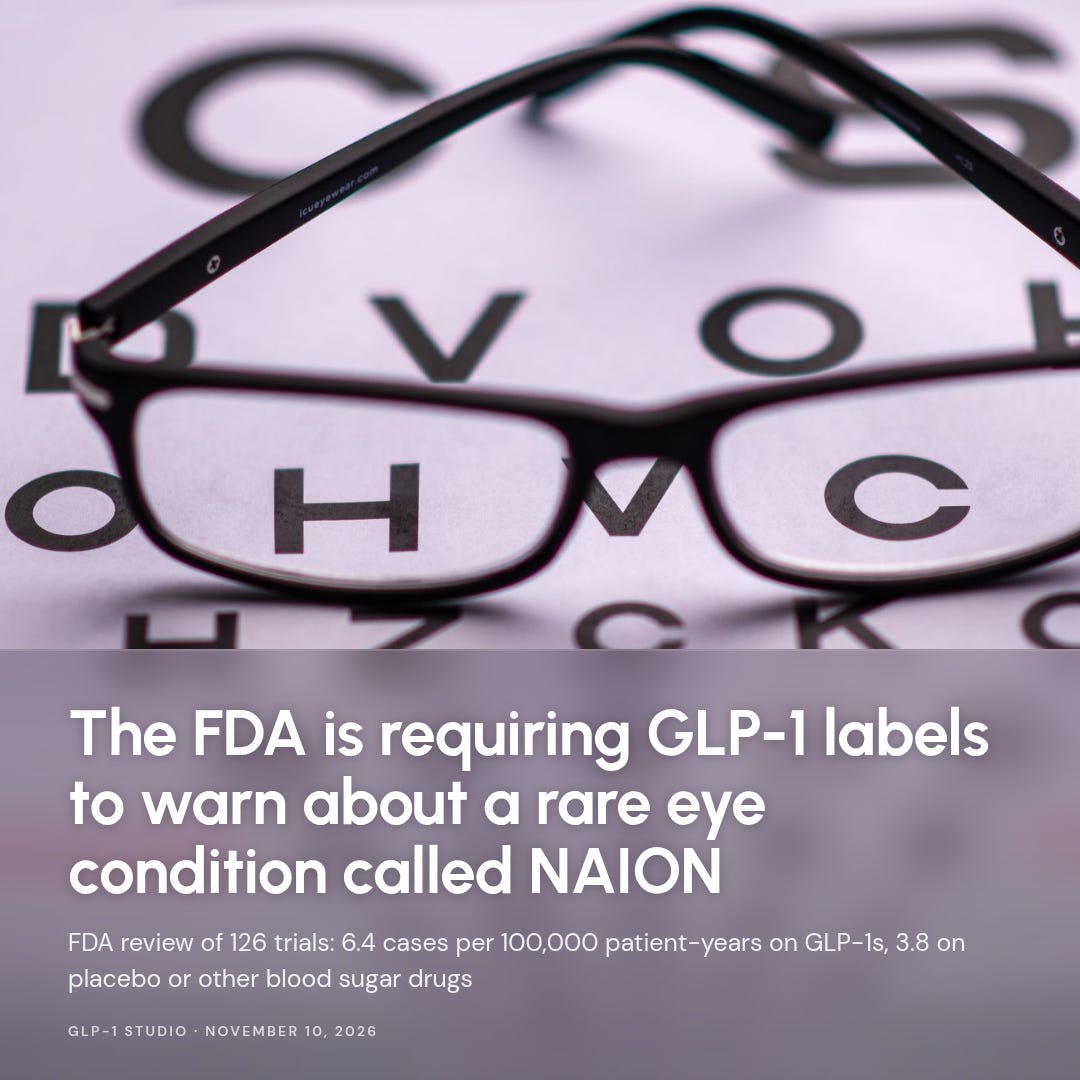
The FDA is requiring GLP-1 labels to warn about a rare eye condition called NAION (NBC News)
Semaglutide lowered blood flow to the womb in a study of pregnant sheep (Mirage News)
A former Hindustan Unilever research director sees fermented foods as a fit for GLP-1 users (NutraIngredients)
Givaudan says fine fragrance spending rose 97 percent in U.S. households using GLP-1s (Premium Beauty News)
The FDA is requiring GLP-1 labels to warn about a rare eye condition called NAION
Key Details:
On Monday, the FDA said every GLP-1 drug must add the warning to its label, including Ozempic, Wegovy, Mounjaro and Zepbound.
NAION is linked to reduced blood flow to the front of the optic nerve, which carries signals from the eye to the brain. It can cause sudden vision loss in one eye, and NBC News reports it is permanent with no known treatment.
In a review of 126 clinical trials, the FDA counted 15 probable cases, 10 in people on GLP-1s and 5 on placebo. That is 6.4 cases for every 100,000 years of patient time on a GLP-1, compared with 3.8 on placebo or other blood sugar drugs.
The agency called it a "potential increased risk" and said its review of animal data did not show how the drugs could raise it. It says patients on GLP-1s with sudden vision changes in one eye should contact their health care professional right away.
Semaglutide lowered blood flow to the womb in a study of pregnant sheep
Key Details:
Researchers at Adelaide University in Australia gave semaglutide, the active ingredient in Ozempic and Wegovy, to pregnant sheep and used MRI scans to measure the mother's heart and blood flow to the uterus before and after.
Within two hours, the mother's heart was pumping significantly less blood, and blood flow to the uterus and oxygen in the fetus went down.
The findings are early, have not been shown in humans, and were shared as a conference abstract in the journal Heart, Lung and Circulation. The report does not say how many sheep were used. Senior researcher Professor Janna Morrison said "Our findings suggest a potential risk to fetal development, but we haven't yet established whether these short-term changes affect fetal growth, what happens over a longer period of semaglutide use or whether similar effects could occur in human pregnancies."
The drug is not recommended during pregnancy, and women planning to get pregnant are advised to stop it beforehand.
Source: Mirage News
A former Hindustan Unilever research director sees fermented foods as a fit for GLP-1 users
Key Details:
Rinka Banerjee, who used to lead research and development for Hindustan Unilever's foods business in South Asia, spoke to NutraIngredients at a food industry summit in Singapore last month. She now runs a food and nutrition consulting firm in Bangalore, India.
She said Asian companies could start a new trend with fermented products for people on GLP-1 drugs. "We ferment our grains and rice, and fermented products benefit the gut microbiome, which is a big opportunity for us."
She pointed to Yakult, saying "It's portion-controlled, dose-controlled and it's fermented," and "That ticks all the boxes for something that a GLP-1 user would be looking for."
These are her views, and the article does not cite a study of fermented foods in people taking GLP-1s. It does cite a review in the journal Nature Health that found stomach and gut side effects like nausea, vomiting, constipation and diarrhea are common with these drugs. The article says those side effects have driven demand for gut support products like fiber.
Source: NutraIngredients
Givaudan says fine fragrance spending rose 97 percent in U.S. households using GLP-1s
Key Details:
Givaudan is a fragrance and flavor company, and every figure here comes from the company. A NielsenIQ survey it presented found U.S. households on GLP-1 drugs are moving spending away from food and toward beauty, sports and travel.
Spending on fine fragrance in those households rose 97 percent. The article does not say over what time period or compared with what.
Studies the company compiled found the share of U.S. adults taking GLP-1s for weight loss went from 3 percent in 2024 to 11 percent in 2026.
From tracking what people say online, it found two kinds of scents that seem to appeal to GLP-1 users: gourmand scents, which smell like food or sweets, and fresh scents. Some people may turn away from certain smells because of nausea. Frédéric Merlin, manager of the Givaudan Digital Factory in Paris, said "The mistake would be to think that GLP-1 only affects people under treatment."
Source: Premium Beauty News
Learn More
Join the free GLP-1 community Cozy Butter: cozybutter.com
Listen to GLP-1 Radio, GLP-1 shows all day: glp1radio.com
Every GLP-1 Studio Daily episode: GLP-1 Studio Daily
About Amanda Bonello: amandabonello.com

This is a reader-supported publication, thank you so much for your support.
💖


