
Good morning! Few insured adults could get GLP-1 drugs for weight loss without a prior approval step. Also today: a leptin pill that cut mouse weight 36% with semaglutide, teens on tirzepatide lowering BMI 19 points more than placebo, and a shot built for monthly to quarterly dosing. Listen to me read them above, or read the key details below.
Daily Roundup:
Few insured adults could get GLP-1 drugs for weight loss without a prior approval step (Medical Daily)
An experimental leptin pill added to semaglutide boosted weight loss in obese mice (PR Newswire)
Teens on tirzepatide lowered their BMI more than teens on placebo in a Lilly-funded trial (Healio)
The company shared early animal results for three experimental weight-loss drugs at ObesityWeek (PR Newswire)
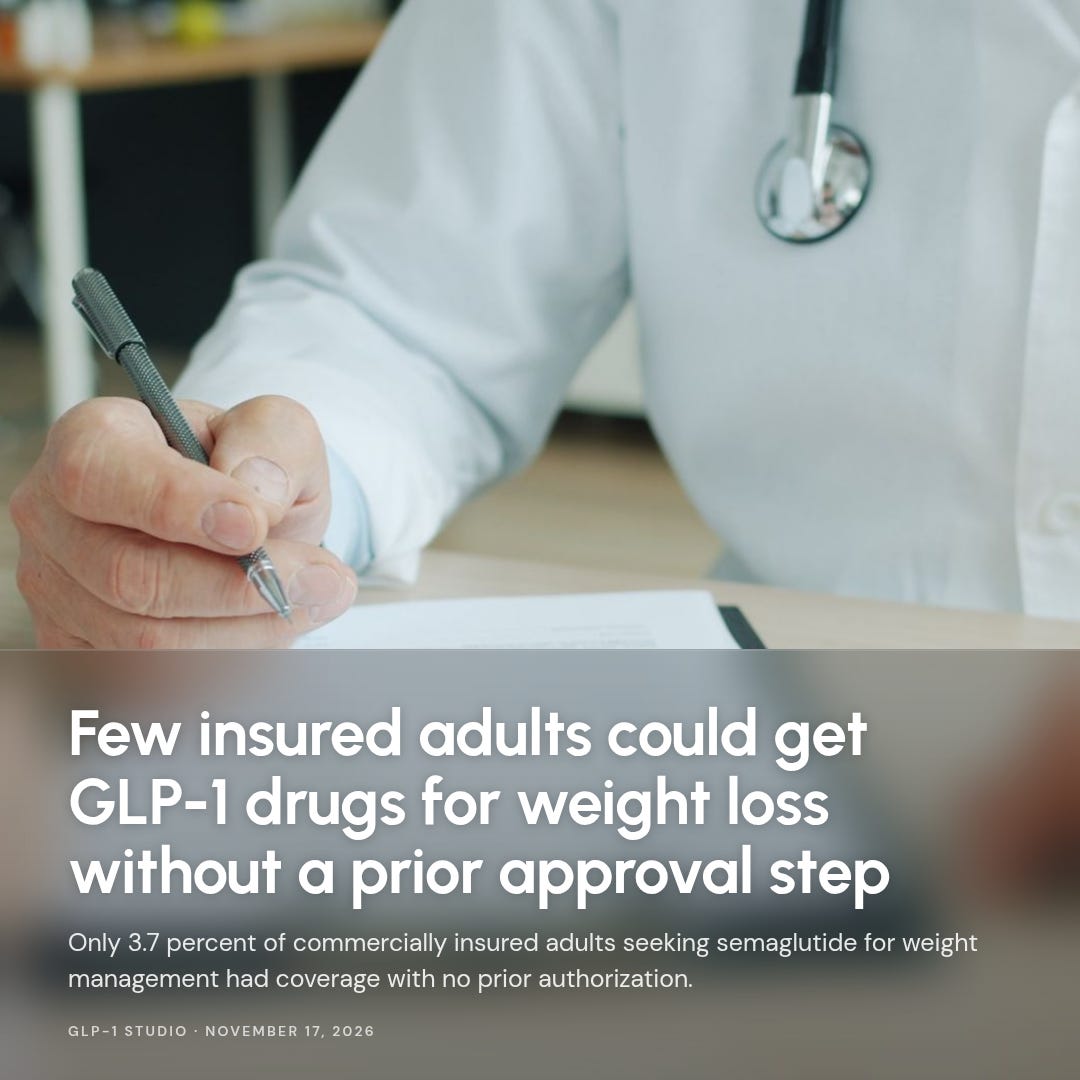
Few insured adults could get GLP-1 drugs for weight loss without a prior approval step
Key Details:
The study used 2025 insurance checks from one telehealth company, and it has not been published in a journal.
Only 3.7 percent of commercially insured adults seeking semaglutide for weight management had coverage with no prior authorization. For tirzepatide, it was 2.8 percent.
Of 69,462 requests to start treatment, 53.2 percent were approved and 35.7 percent were denied.
Just over half of the denials, 51.1 percent, came from plan exclusions or coverage limits.
Source: Medical Daily
An experimental leptin pill added to semaglutide boosted weight loss in obese mice
Key Details:
Dr. Louis Aronne of Weill Cornell Medicine, who sits on the company's board, presented the results November 15 at ObesityWeek in Washington, D.C.
After 35 days, the combination cut body weight by 36 percent after accounting for placebo, compared with 18 percent for the pill, ERX1000, alone and 14 percent for semaglutide alone.
Aronne said the combination "may mean patients can lower their GLP-1 dose and reduce accompanying side effects."
The pill is now in a Phase 2a trial in people with obesity, expected to finish in the second half of 2027.
Source: PR Newswire
Teens on tirzepatide lowered their BMI more than teens on placebo in a Lilly-funded trial
Key Details:
The trial included 160 teens aged 12 to 17 with obesity or overweight, who got a weekly shot or a placebo for 72 weeks, along with lifestyle support. The results were presented at ObesityWeek and published in JAMA.
BMI fell 19 percentage points more with the drug than with placebo, and 48.1 percent of teens on it cut their BMI by 20 percent or more, compared with 7.9 percent on placebo.
Stomach and gut side effects affected 81.5 percent of teens on the drug, and 9.3 percent stopped because of side effects.
Dr. Claudia Fox of the University of Minnesota said, "There are no signals of disruption to growth and maturation in this trial."
Source: Healio
The company shared early animal results for three experimental weight-loss drugs at ObesityWeek
Key Details:
In monkeys, a combination pill called ASC30_48 cut body weight by 10.5 percent by day nine, compared with 6.9 percent for ASC30 alone and 1.7 percent for ASC48 alone.
A shot called ASC37 is designed to be given once a month to once every three months. Its half-life in monkeys was 372 hours, about 15 and a half days, compared with 57.8 hours for retatrutide.
In obese mice given daily shots, the highest dose of ASC37 cut body weight by 41.5 percent by day 12, compared with 4.7 percent for mice given an inactive shot.
The company's lead drug, a once-daily GLP-1 pill called ASC30, is in two global Phase 3 obesity trials.
Source: PR Newswire
Learn More
Join the free GLP-1 community Cozy Butter: cozybutter.com
Listen to GLP-1 Radio, GLP-1 shows all day: glp1radio.com
Every GLP-1 Studio Daily episode: GLP-1 Studio Daily
About Amanda Bonello: amandabonello.com

This is a reader-supported publication, thank you so much for your support.
💖


