

Good morning! GLP-1 prescriptions for weight loss fell sharply in four states after Medicaid stopped paying for them. Also today: a JAMA summit report on insurance barriers to obesity care, 5.4% vs 13.5% lung disease with GLP-1s in systemic sclerosis, and an FDA filing for a weekly four-target obesity pill. Listen to me read them above, or read the key details below.
Daily Roundup:
GLP-1 prescriptions for weight loss fell sharply in four states after Medicaid stopped paying for them (ReadMedia and Medical Daily)
A JAMA summit report lays out insurance, drug and food policy steps to go with obesity medicines (AJMC)
People with systemic sclerosis and obesity who took GLP-1s had fewer lung problems in a look back at health records (Healio)
Ascletis asked the FDA to let it start testing a weekly pill aimed at four obesity targets (PR Newswire)
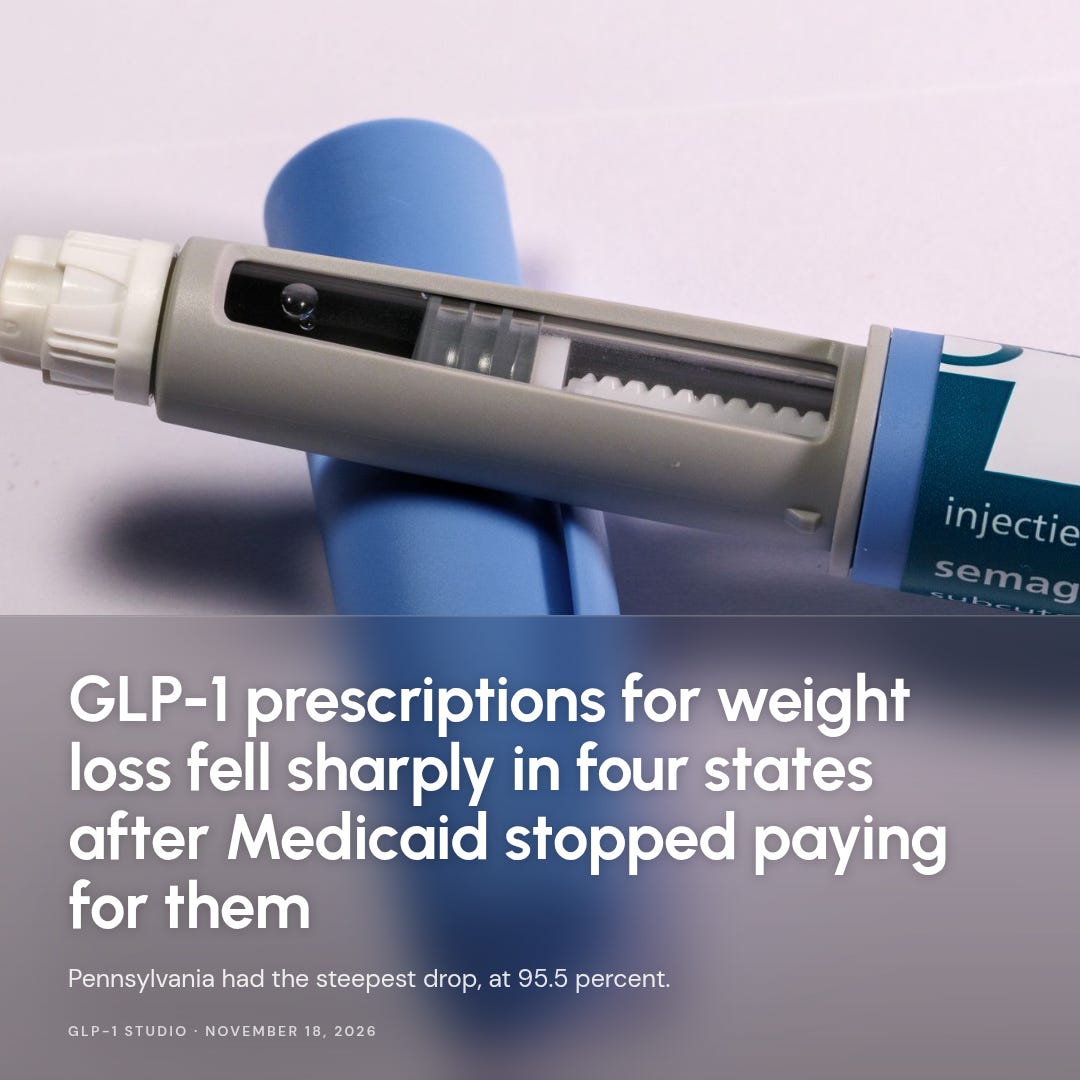
GLP-1 prescriptions for weight loss fell sharply in four states after Medicaid stopped paying for them
Key Details:
The study came out in JAMA on November 16, and a second-year student at Geisinger College's School of Medicine is one of its authors.
California, New Hampshire, Pennsylvania and South Carolina ended Medicaid coverage of GLP-1s for weight loss on January 1, 2026.
In those states, prescriptions per 100,000 people on Medicaid went from 2,914 in the last three months of 2025 to 421 in the first three months of 2026.
Pennsylvania had the steepest drop, at 95.5 percent.
Source: ReadMedia and Medical Daily
A JAMA summit report lays out insurance, drug and food policy steps to go with obesity medicines
Key Details:
The report says the insurance system discourages obesity treatment by not covering it or by requiring heavy prior authorization.
It says the Medicare GLP-1 Bridge and a Medicaid program called BALANCE could be expanded if they work.
The authors also called for stronger enforcement against compounded copies of FDA-approved drugs when there is no shortage.
They wrote, "no single intervention will be enough."
Source: AJMC
People with systemic sclerosis and obesity who took GLP-1s had fewer lung problems in a look back at health records
Key Details:
Researchers compared 1,578 pairs of patients who did or did not use GLP-1s, and presented the results at ACR Convergence in Orlando.
Over 10 years, 5.4 percent of GLP-1 users developed interstitial lung disease, compared with 13.5 percent of non-users.
Pulmonary hypertension, high blood pressure in the lungs, showed up in 6.5 percent of users and 15.1 percent of non-users.
Dr. Aseed Mestarihi of the University of Central Florida said, "We acknowledge that these results are not practice changing, and that these are just hypothesis-generating."
Source: Healio
Ascletis asked the FDA to let it start testing a weekly pill aimed at four obesity targets
Key Details:
The Hong Kong-listed company filed an Investigational New Drug application, the request to begin human trials, for a pill code-named ASC36_37o FDC.
The tablet combines two drugs that act on the amylin, GLP-1, GIP and glucagon receptors.
In rat studies, the combination led to about 69 percent more weight loss than one of those drugs alone.
The company has also started a US phase one study of a related pill, ASC36o, with first data on how the drug moves through the body expected by the end of 2026.
Source: PR Newswire
Learn More
Join the free GLP-1 community Cozy Butter: cozybutter.com
Listen to GLP-1 Radio, GLP-1 shows all day: glp1radio.com
Every GLP-1 Studio Daily episode: GLP-1 Studio Daily
About Amanda Bonello: amandabonello.com

This is a reader-supported publication, thank you so much for your support.
💖


