


Some stories stop you cold.
Kristi Turner’s was one of those for me.
I created this piece through the GLP-1 Collective, which I founded and still lead as executive director. By the time I wrote it, I’d heard hundreds of stories about denied coverage, rationed doses, impossible choices. But something about Kristi’s hit different.
Maybe it was the timing—finding out on New Year’s Eve that her medication had been quietly removed from the formulary. Maybe it was the absurdity of what came next: a licensed mental health therapist being told she’d need to complete behavioral therapy sessions to prove she deserved coverage. Maybe it was just the accumulation of all of it, story after story, piling up until something had to give.
2025 was brutal for GLP-1 access. I watched the cutbacks roll in like a slow-motion disaster. Independence Blue Cross. Blue Cross Blue Shield of Michigan. Kaiser. MassHealth. One by one, insurers tightened restrictions or dropped coverage entirely. Millions of people affected. Real people, not statistics.
And the cruelest part? The data was already there. Studies showing reduced disability claims. Lower long-term healthcare costs. Better outcomes across the board. Employers who covered GLP-1s weren’t just doing the right thing—they were making a smart investment.
But data alone wasn’t moving the needle.
That’s when we started organizing. Contact Congress Day wasn’t about one petition or one letter. It was about showing up together—patients, providers, advocates—and demanding that the people making policy decisions actually listen to the people living with the consequences.
Kristi’s story became part of that. So did Amanda’s. And Stevie’s. And Jen’s. Each one a reminder that behind every coverage denial is a human being whose health and dignity are on the line.
I don’t know if our coordinated effort changed anything in Washington. Policy moves slowly, and the forces working against access have deep pockets and loud voices. But I know that staying silent wasn’t an option. And I know that every time someone shares their story, it chips away at the stigma that makes it so easy for insurers to say no.
This work mattered then. It still matters now. And I’m proud it has a home here.
Below is the complete article as originally published in May 2025.

One Woman’s Fight for Dignity, Equality, and GLP-1 Access for All
May 29, 2025
In 2025, insurance coverage for GLP-1 medications has become increasingly restrictive, leading to a significant number of patients losing access to these treatments.
A report from GoodRx shows how commercial insurance coverage has shifted from 2024 to 2025:
Zepbound (tirzepatide): The number of people without coverage increased by 14%, leaving 4.9 million more people uninsured.
Ozempic (semaglutide): There was a 22% increase in people losing coverage, affecting an additional 1.1 million individuals.
Wegovy (semaglutide): Fewer people had full (unrestricted) coverage. More plans required prior authorizations, and a growing number offered no coverage at all.
Mounjaro (tirzepatide): Unrestricted coverage dropped by about 5%, while the percentage of people with no coverage rose by 3%—meaning more people were shut out, even though Mounjaro is FDA-approved for Type 2 diabetes.
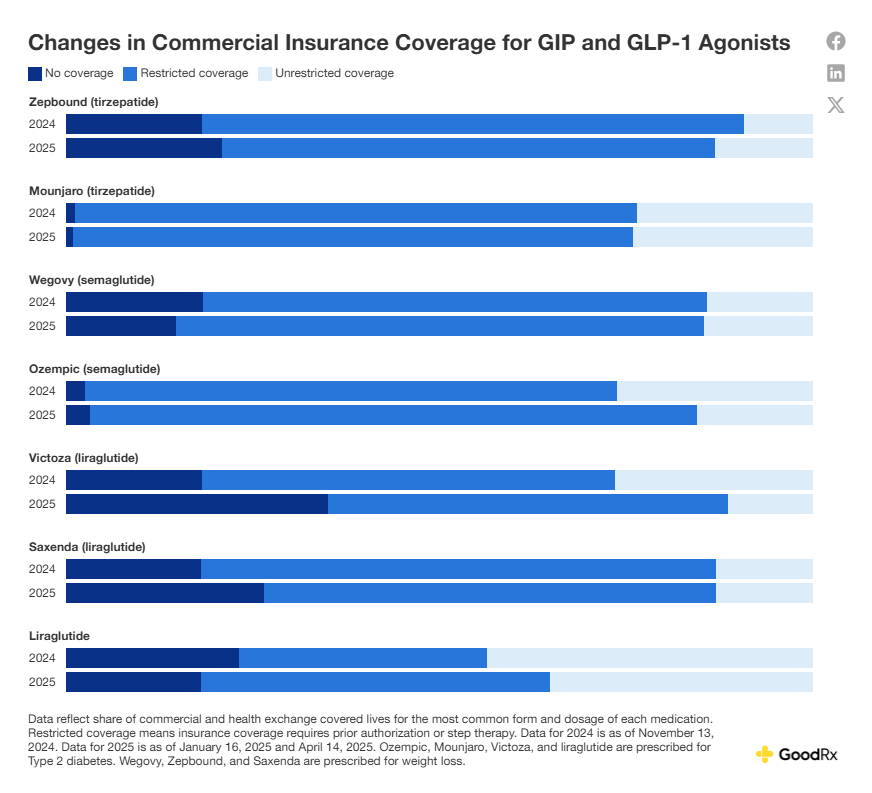
At first glance, it might seem like GLP-1s are widely covered—but the reality is far more complicated.
These medications have quickly become one of the biggest drivers of pharmacy spending—and employers are feeling the pressure. An overwhelming 96% of employers say they’re concerned about the long-term financial impact of GLP-1 use across their health plans.
However, even when employers want to offer coverage, some are running into a different barrier: they can’t find a formulary that even includes GLP-1s as an option.
We spoke with one employer who described combing through every available plan—only to realize not a single one listed GLP-1 medications for weight loss.
Jennifer Sansabrino, a small business owner, shares her experience trying to secure GLP-1 coverage for her employees. Despite actively searching, none of the available formularies included GLP-1 medications for weight loss. This clip highlights how even employers who want to support their teams are being blocked by limited insurance options.
This shows that the barriers to access go beyond what most people assume. It’s not always the employers who are unwilling—sometimes they’re just as trapped by limited formularies and restrictive policies. The hurdles to getting these medications are on a whole different level.
This reflects a growing trend across the country: insurance plans are quietly shifting, and the result is fewer options, more restrictions, and less clarity.
Here are some of the most alarming insurance cutbacks we’ve seen so far:
🔻 Insurance Cuts in 2025
Independence Blue Cross: Will stop covering GLP-1s for weight loss.
Blue Cross Blue Shield of Michigan: Ending GLP-1 coverage for weight loss under large group commercial plans—affecting ~10,000 members.
Allina Health (MN): Cutting GLP-1 coverage for weight loss from its employee health plan.
Point32Health (Tufts & Harvard Pilgrim): Rolling out new restrictive formularies in ME & RI.
MassHealth: As of January 2025, Wegovy and Saxenda will be removed for most adults. Patients must try phentermine first.
BCBS Federal Employee Program (FEP): Reducing coverage for GLP-1s, moving them to non-covered formulary tiers.
Kaiser Permanente (CA): Dropping GLP-1 coverage for patients with BMI <40 when used for weight loss alone.
Chevron Prescription Drug Program: Now requires virtual coaching, weigh-ins, and minimum weight loss to continue GLP-1 coverage.
Medicare Part D: continues to exclude coverage unless for diabetes, cardiovascular disease, or sleep apnea.
These aren’t abstract policy shifts—they’re disrupting lives in real time. Patients are being pulled off treatments that worked, and providers are left helpless, forced to watch their patients suffer.
As one Washington Post investigation reported, patients are navigating what one obesity specialist called an “absolutely insane” maze of insurance denials, cost barriers, and constant policy shifts. Even experienced providers are struggling to keep up with changing coverage rules—and patients without system knowledge are often forced to give up.
After fighting for a year to access the medication that finally helped, Amanda was devastated when her insurance company abruptly pulled coverage in January 2025.
Shockingly, even individuals with Type 2 diabetes are being cut off as insurers tighten their policies.
In this clip, Stevie explains how switching jobs caused her to lose coverage for Mounjaro—even though it had helped her lose 30 pounds and manage both Type 2 diabetes and PCOS for over two years. Her new insurance plan refuses to cover it and wants her to switch to older medications like Victoza or Trulicity, which don’t work nearly as well for weight loss or metabolic control.
More than half of the people who could benefit from these medications lack reliable insurance access. And even when coverage exists, it often comes with strings attached: 83% of commercial insurance plans require prior authorization or step therapy—or both—for GLP-1 medications prescribed for obesity.
Patients are trapped in cycles of delays, denials, and appeals—postponing care, risking relapse, and putting their health in jeopardy.
Step therapy protocols often place a significant financial and logistical burden on patients.
According to the American Urological Association, these ‘fail first’ protocols can result in increased out-of-pocket costs, frequent healthcare visits, and lost productivity due to time away from work.
And the impact is more than just inconvenience—it’s often harmful.
Nearly 1 in 3 physicians say step therapy has led to serious patient health consequences, including hospitalization or permanent disability.
This isn’t about responsible cost control. It’s about rationing care.
Many patients never make it through the system. They’re forced to restart failed treatments, fight appeals, or give up entirely.
Some regain weight, lose control over their diabetes, or face new complications.
These findings underscore the need for more patient-centered approaches in healthcare policy, ensuring that cost-containment strategies do not come at the expense of patient well-being and access to effective treatments.
🟥 Over 19 million commercially insured Americans still have zero coverage for GLP-1s prescribed for weight loss.
But for those who do have insurance, affordability remains a barrier.
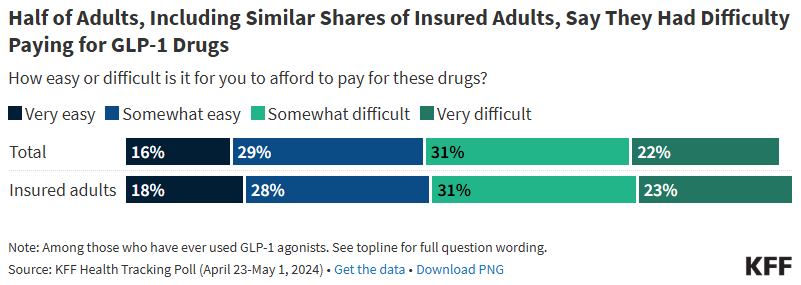
A real-world study by Truveta confirmed what patients already know: cost stops care. 12.8% of patients discontinued GLP-1 treatment not because it wasn’t working—but because they simply couldn’t afford to continue.
Making matters worse, the FDA has ended emergency authorization for pharmacies to compound exact copies of semaglutide and tirzepatide.
This decision, removes a lower-cost alternative that a millions of patients rely on.
Meanwhile, manufacturers have declared the GLP-1 shortage “over”—but availability doesn’t equal access.
With compounded medications restricted, patients have lost a critical safety net—and nothing has taken its place. If the FDA is firm on limiting compounded alternatives, then the burden shifts squarely to manufacturers and insurers.
Prices must come down, or coverage must expand—because the current system is failing.
But while policymakers stall and access crumbles, patients aren’t staying silent. Across the country, people are sharing their stories, pushing back, and demanding change.
One woman is fighting for everyone.
Kristi Turner never expected to become an advocate. But when her school district’s benefits plan abruptly cut off her access to the life-changing medication that her doctor prescribed, she refused to accept it quietly.

After her husband’s employer, Carmel Clay Schools of Carmel, IN, changed its pharmacy benefit manager, her access was suddenly threatened. The new PBM, Optim RX, initially claimed it would continue covering GLP-1s for weight loss and even sent her a formulary showing her medication as covered. But on New Year’s Eve, while others celebrated, Kristi was anxiously refreshing the formulary site, hoping to see her medication on the list.
It wasn’t. The drug had been removed.
She called the PBM, desperate for answers. One representative told her it was too expensive to cover. Another said they were worried about the long-term health effects—despite decades of safety data.
Eventually, Kristi was told she could still “potentially” get coverage if she enrolled in the district’s new step therapy program: the Pathways Program—which Kristi bluntly refers to as “Adult Fat Camp.”
The Pathways Program felt like a slap in the face. Kristi was already under the care of a board-certified obesity specialist.
To regain coverage, she was told she’d have to stop seeing her specialist and instead go through a step therapy protocol dictated by the insurer. That meant switching to a general primary care provider and completing a checklist that included behavioral therapy sessions.
Kristi is a licensed mental health therapist. She’s not only trained in behavioral health—she’s done her own work, faced her challenges, and already experienced the breakthroughs that helped her change her relationship with food. For her, this wasn’t just unnecessary. It was insulting.
This is about more than coverage. It’s about standing up to the stigma and discrimination that people living with obesity face every day—and demanding a healthcare system that treats them with dignity.
Kristi’s experience isn’t unique. Across social media, news headlines, and everyday conversations, countless others are facing the same reality.
For every heartbreaking story of denied access, there’s a growing body of research showing one simple truth:
Covering GLP-1 medications isn’t just the right thing to do—it’s the smart thing to do.
Scientific studies and employer case reports consistently show that when people have access to GLP-1 treatments, they get healthier—and that translates into measurable benefits for their employers.
A 2023 Obesity journal study found that GLP-1 therapy led to a 30% reduction in obesity-related short-term disability claims. Employees on these medications simply miss fewer days of work due to illness or complications.
GLP-1s don’t just help with weight—they improve energy levels, sleep, blood sugar control, and inflammation. That means fewer crashes during the day, better focus, and stronger day-to-day performance.
While the up-front cost of GLP-1 medications can be high, multiple studies show that they reduce overall healthcare spending by preventing costly complications like cardiovascular events, sleep apnea, and uncontrolled diabetes. One analysis from Diabetes, Obesity & Metabolism showed a 16% drop in total medical costs within a year of starting treatment.
Employers who offer GLP-1 coverage signal that they value employee well-being. That builds trust, loyalty, and job satisfaction—especially for employees managing chronic metabolic conditions.
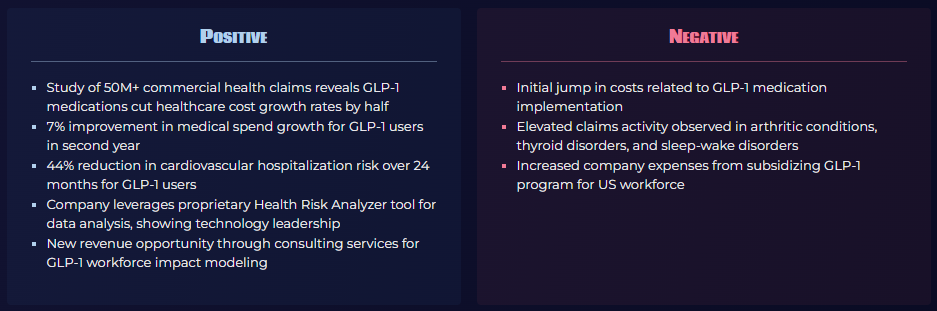
“Aon researchers found that within two years, patients taking GLP-1 drugs saw improved health outcomes, which significantly slowed the growth rate of their medical costs. The rate of growth, known as the medical cost trend – was cut roughly in half, the researchers said.”
That’s not just a win for patients. That’s a win for employers, insurers, and the healthcare system as a whole.
The Case Is Clear—So Why Are People Still Being Cut Off?
Data alone isn’t enough.

The GLP-1 Collective is launching a coordinated “Contact Congress” Day—a nationwide effort to demand action and accountability.
Because sharing our stories isn’t enough but a coordinated, collective action can urge Congress to:
Ensure Fair Insurance Coverage: By exploring policies that require insurance plans to include obesity and metabolic treatments—not just for diabetes, but for all FDA-approved uses.
Reform Pharmacy Benefit Managers (PBMs): Congress can help rein in PBMs by increasing transparency, limiting exclusionary practices, and reducing the administrative red tape that blocks patients from getting care.
Address Medication Affordability: Lawmakers can support initiatives to lower the cost of GLP-1s and reduce the burden on patients and small employers alike.
This isn’t just about medication. It’s about equity, dignity, and quality of life.
The GLP-1 Collective is here to fight for affordable access, with Kristi and for Amanda, for Stevie, and for the millions of people being left behind.
Join the movement!


