


I met Barb Herrera at Your Weight Matters this year. I recognized her tiny frame and beautiful bald head from across the room and immediately went over to introduce myself.
Nearly 300 Pound Weight Loss on a GLP-1


I had been following her story on Substack, where she’s shared openly about losing nearly 300 pounds with the help of a GLP-1, while living with cancer, and everything her body has been through along the way. I wanted to thank her for being willing to share so much of it publicly.
That’s when Barb told me that two of her children were also on GLP-1s.
I didn’t know anything about their individual stories. I just knew it would be fascinating to hear three people from the same family talk about their experiences together.
I was not prepared for how much their stories would stick with me afterwards.
Together, they’ve lost about 445 pounds


Barb is a retired midwife, writer, and GLP-1 advocate.

Her daughter, Meghann Dibrell, is the creator of Small Things Daily, where she shares her own experience losing 125 pounds with the help of a GLP-1 and what maintenance looks like afterwards.


Her son, Tristan Lora, works as a Director of Operations at NASCAR and has been on and off GLP-1 medications for the past several years.
Three people from the same family, all with completely different experiences battling obesity.
Obesity is highly heritable
One of my favorite facts from the Strong Framework is that research estimates the heritability of BMI at somewhere around 40 to 70 percent.
Which is comparable to height.
We would never tell a tall person they should just will themselves shorter! But society says we should just eat less, move more, and try harder.
In a large international meta-analysis, children with parents who had overweight or obesity had more than twice the odds of having overweight or obesity themselves.
That doesn’t mean genes are destiny, but genetics are a major part of the equation.
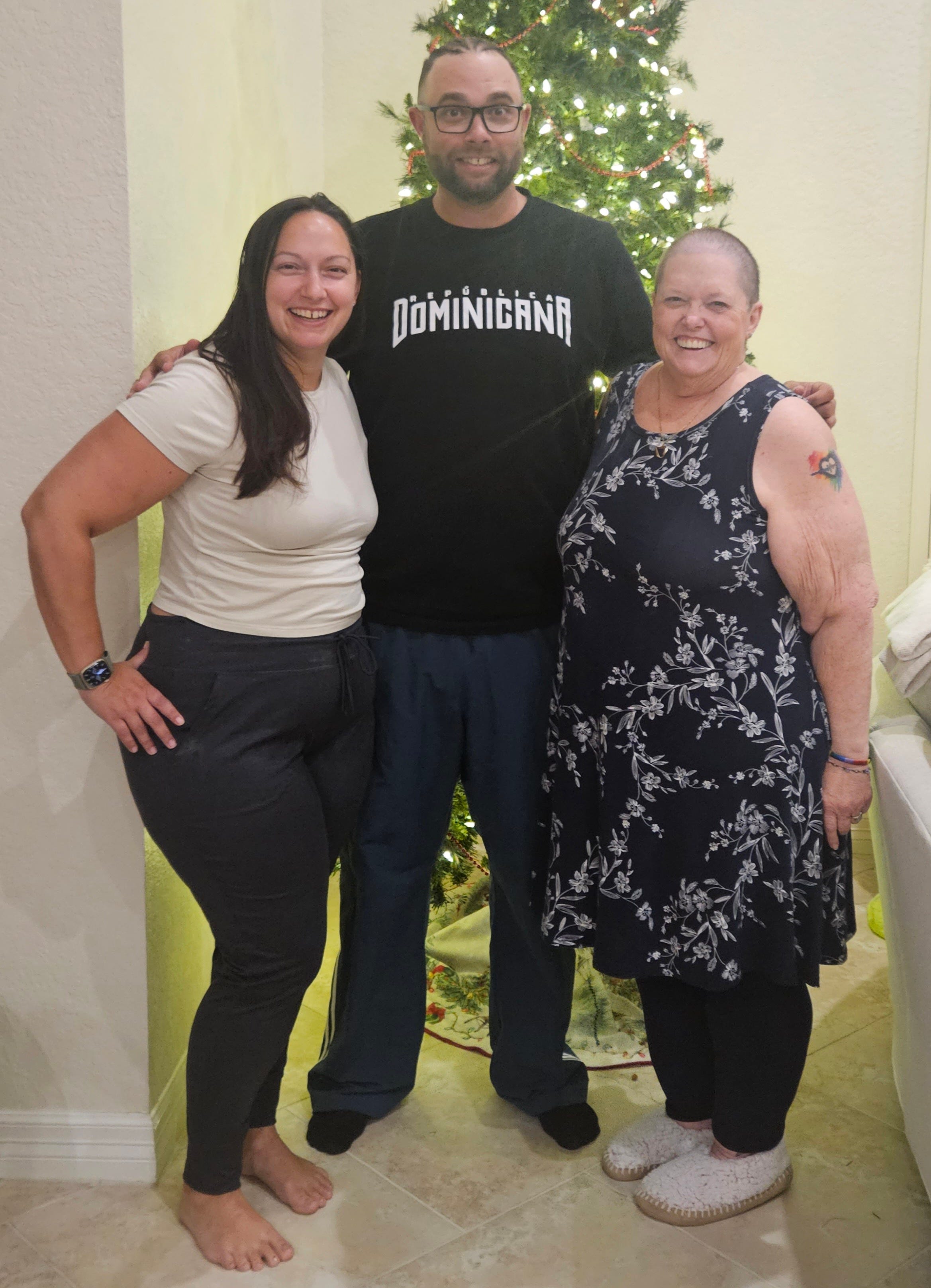
Barb had lived in a very large body for most of her life. At 5’1”, she once weighed 405 pounds.
Meghann started struggling with her weight, gaining 75lbs in just a year, after having three children.
Tristan had been extremely active for most of his life. He played sports, hiked, biked, lifted weights, and is now heavily involved in pickleball. He has also been vegan for the last 12 years and was vegetarian before that.
Three people from the same family, with three very different experiences with obesity.
Regain After Weight Loss on a GLP-1


Tristan said something that I hear often as a health coach,
“I feel like I have a really good routine, a good system, I’m gonna eat well and continue working out, and I thought I had beaten it...”
He worked hard to build muscle, developed healthy habits, and maintained his vegan diet.
So he came off the medication.
And he regained.
He went back on treatment, lost the weight, and gained it back again.
He has stopped GLP-1 treatment three times.
The third time, he approached it almost like an experiment.
He and his wife went to safe as to weigh their food. He continued resistance training. and stayed extremely active. He wanted to know whether he could maintain his weight now that he had built all of these habits.
And the weight started creeping back anyway.
Eventually, the food noise came back too.
He restarted treatment in February.
People are often angry when they hear that they may not be able to stop these medications without regaining weight.
And I understand why.
GLP-1s are unfairly priced, and insurance coverage is unpredictable and increasingly limited.
But losing weight is not just about losing weight. It’s about treating a chronic disease.
The Definition of Obesity
The 2025 Standards of Care in Overweight and Obesity describes obesity as a chronic, relapsing, and progressive disease requiring long-term treatment strategies:
Chronic means it persists over time.
Relapsing means that after successful treatment, the disease can return or worsen when treatment is removed.
Progressive means it can worsen over time.
That doesn’t mean every person with obesity will follow exactly the same path. It does mean that reaching a goal weight does not necessarily mean the underlying disease is gone.
And we have data that shows us what can happen when GLP-1 treatment is withdrawn.
In one clinical trial, participants who stopped semaglutide regained about 2/3 of the weight they had lost within one year.
We saw the same basic pattern with tirzepatide.
In another clinical trial, participants first lost an average of 20.9% of their body weight during 36 weeks of tirzepatide treatment. Those who were then switched to placebo experienced about 14% weight regain over the following 52 weeks.
Weight regain is a well-documented part of obesity.
Tristan was no exception.


Weight Gain After Giving Birth


When Meghann started describing her relationship with food before GLP-1 treatment, it sounded very familiar to me.
“Even if I would tell myself, ‘No, I just need to run to the library. I am not going to stop at McDonald’s,’ if there was a McDonald’s in my path, my car was on autopilot. It would just turn into the drive-thru.”
Before using a GLP-1, I could hardly drive home from work without stopping somewhere, usually for the highest-calorie food I could find.
Then I would gorge myself at a rapid pace, trying to finish before I got caught, and hide the evidence. I hated myself for it, but no matter how hard I tried, I could not stop myself.
People who don’t struggle with food noise can have a really difficult time understanding what that feels like.
From the outside, it looks like a choice.
What is Food Noise?
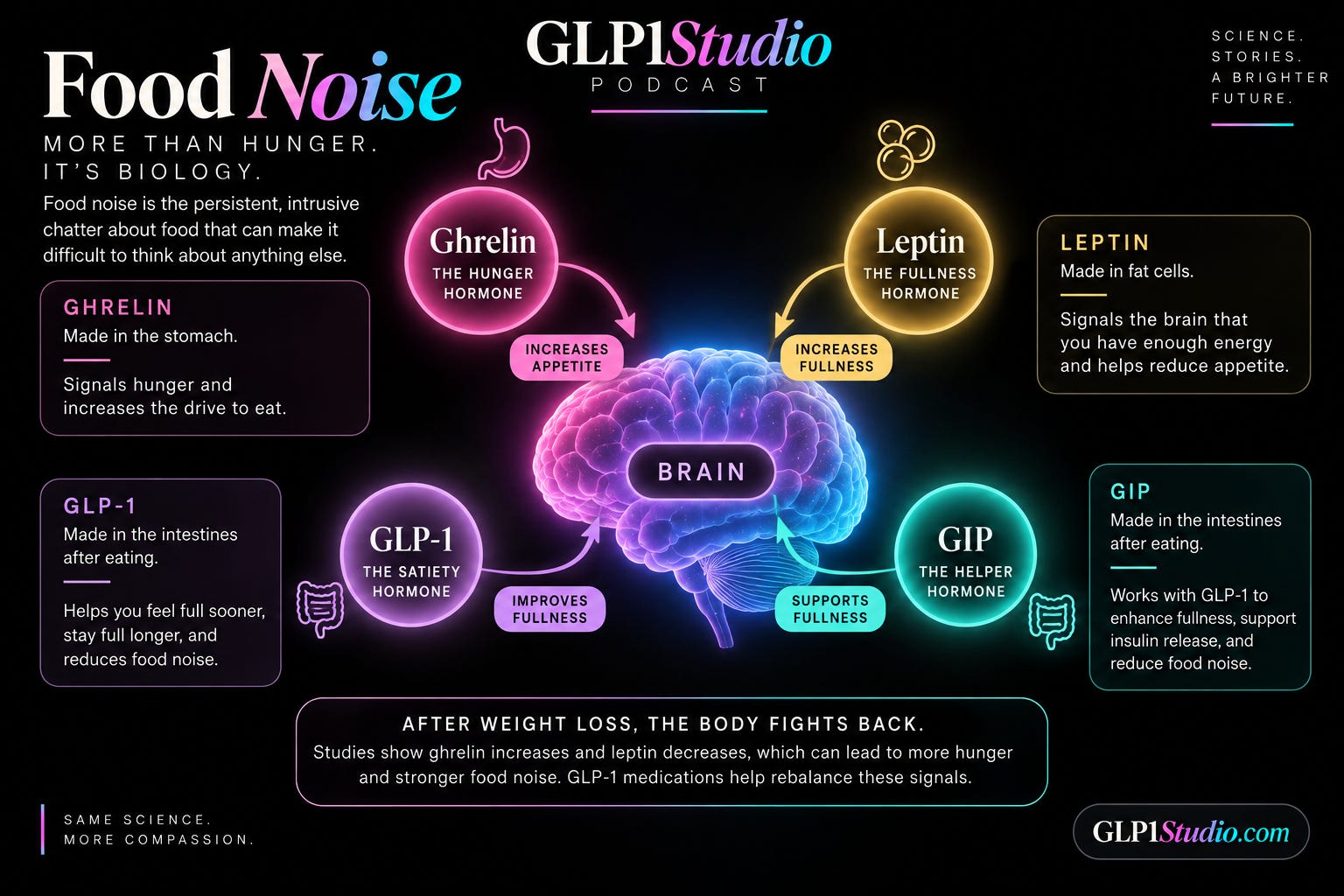
Food noise is the persistent, intrusive chatter about food that can make it difficult to think about anything else. There is scientific evidence that helps explain why that chatter can become so hard to ignore, especially after weight loss.
The body fights against weight loss.
In one clinical study, researchers measured hormones involved in hunger and fullness before and after people lost weight.
After weight loss, their bodies changed in ways that encouraged them to eat more:
Ghrelin, a hormone that stimulates hunger, increased.
Leptin and several other signals associated with fullness and energy regulation decreased.
And people reported feeling hungrier.
Many of those hormonal changes were still elevated a year later.
When your body is telling you that you’re starving, you barely have a choice.
We still blame ourselves


I frequently have conversations with people who understand that obesity is a disease but somehow still believe their obesity is their fault.
They’re still upset that they “let themselves get this way” and ashamed that they couldn’t control themselves.
Barb talked about the history of diabetes in her Cuban family. Her father, aunts, uncles, and grandfather had all lived with diabetes or died from complications related to it, and she knows there is a strong genetic component to what happened in her own body.
And yet, sitting there with two of her children, she still blamed herself, saying, “There’s parts of me that feel guilty. Even the parts that are genetic.”
Then she cried as she talked about passing those genetics down to her children.
“I try hard to not feel so guilty about it, but I do. I feel really bad, and I’m sorry, kids.”
Here was a staunch obesity advocate who, knew that generations of diabetes ran in her family, that she suffered from severe obsity and her children as well, and she still felt guilty for passing them down.
We can accept the science, but after a lifetime of being told our weight is our fault, it’s difficult to let go of that blame.
Luckily for Barb, her kids understand firsthand. They know what it feels like to live with obesity, to need treatment for it, and to realize that it was never your fault.
And if you’re still blaming yourself for your weight, I hope stories like theirs help you understand what the science has been telling us all along: obesity is a disease, not a personal failure.
Follow Barb & Meghann

Barb Herrera | The Metabolic Midwife
Substack
YouTube
Meghann Dibrell | Small Things Daily
Instagram
YouTube


