
Have you lost GLP-1 coverage through your employer? Or maybe you never had it to begin with because it was just “too expensive.”
I have sat with more patients than I can count and they all say the same thing: losing access is traumatizing, and it permanently changes how people feel about the employers who cut them off.
The data backs this up. People are ready to walk. But you might not have to.

Key Details:
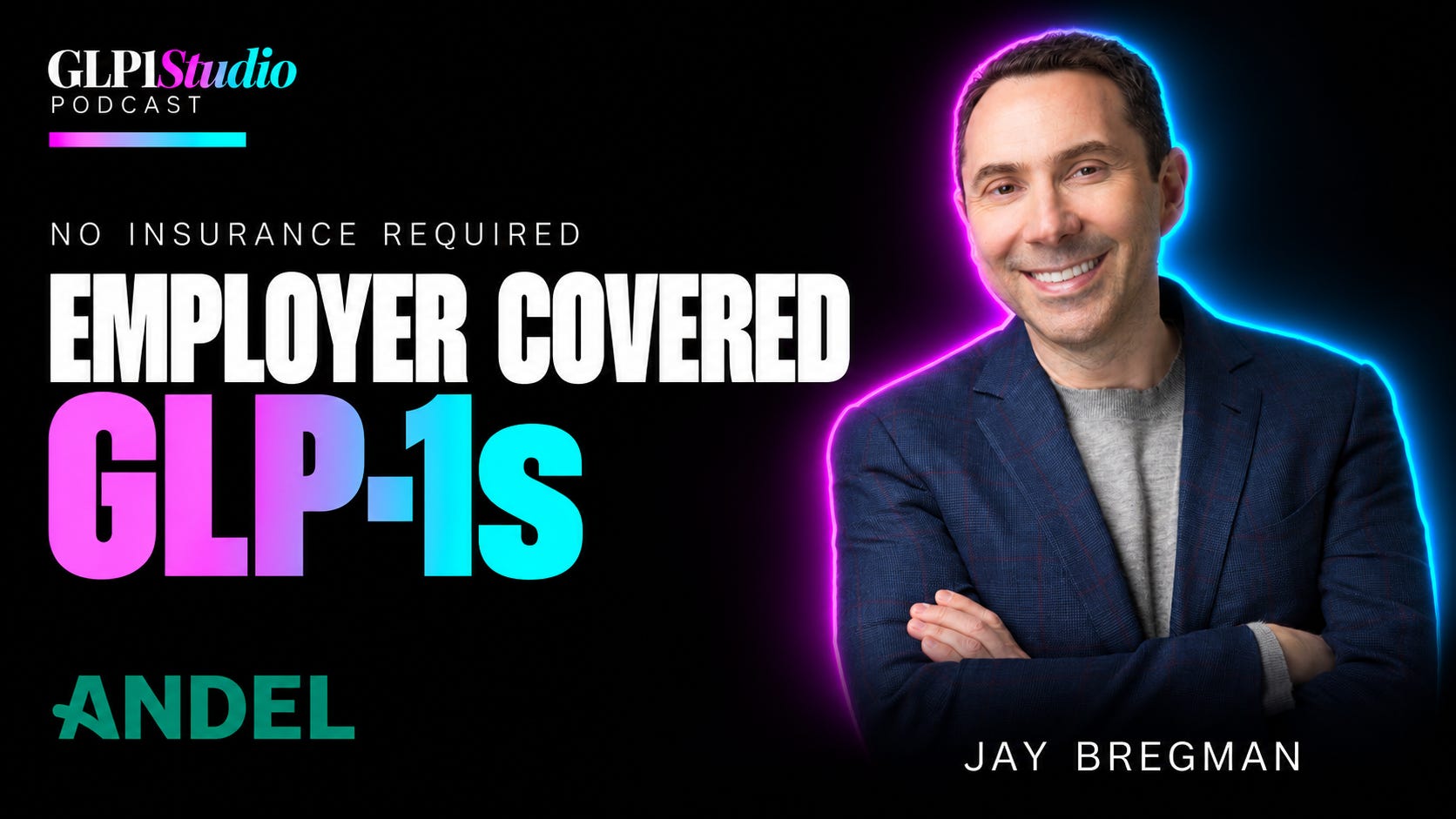
Eli Lilly launched its Employer Connect program in March 2026 with more than 15 independent partners, each offering a different model for employers to cover Zepbound. Andel is one of those partners.
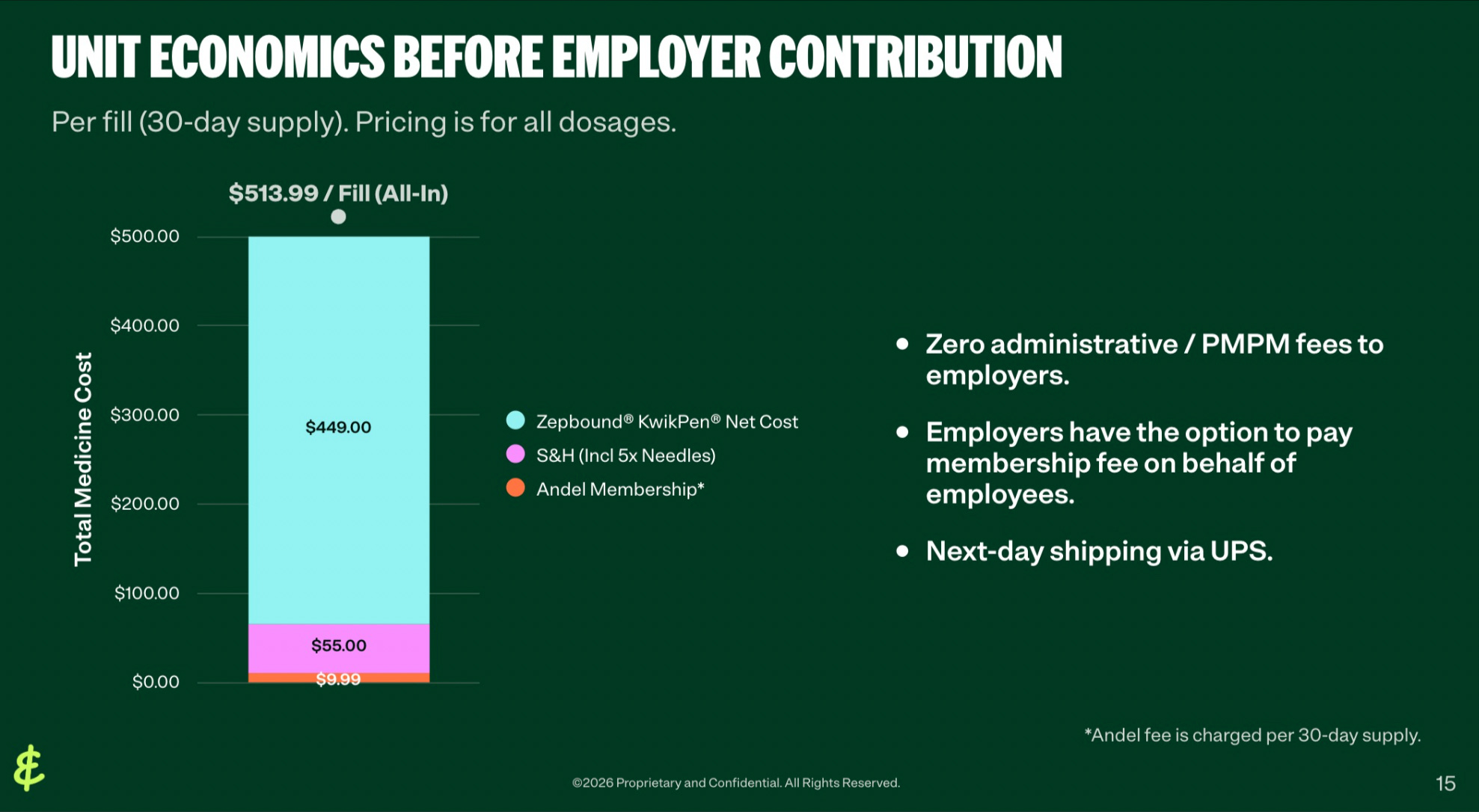
Andel is a cooperative technology platform with no PMPM fees, no administrative overhead, and a membership fee of only $9.99 per fill. The all-in cost before employer contribution is $513.99 per 30-day fill.
Employer contributions start at a minimum of $50 per fill with no ceiling, bringing employee out-of-pocket costs down to as little as $213.99 per fill at a $300 employer contribution.
There is no prior authorization, step therapy, or utilization management. The prescriber decides and the medication ships next day via UPS.
Employees do not have to wait for HR to find this. They can refer their own employer directly at andel.org/referral.
How We Ended Up Here
Coffee & Beignets.
I was sitting in a New Orleans airport café, laptop plugged in, working on the “I used to think it was my fault” video we filmed during the OAC’s social listening session at the regional Your Weight Matters conference.
The powdered sugar situation was fully out of control when I looked up and saw Tracy Zvenyach waiting at her gate, right next to mine.
The universe, am I right?
Tracy handles advocacy for the Obesity Action Coalition. We just spent Mardi Gras together. And here she was, four feet away, gate B12 or whatever it was, waiting for the same connection window.
I am sort of an idea person, give me a riddle and I will figure it out one way or another. She asked me what we could do to help get this medication into the hands of the people who need it.
I took that question home and got to work.
I thought I had it all figured out when I sent her a pitch for a group buy program through employers.
The Affordable GLP-1 Solution
With enough people pooling purchasing power through their workplace, the group creates real leverage directly with manufacturers, the same way a buying cooperative negotiates better prices than any single buyer could on their own.
My husband's job does something similar. He meets certain health criteria and gets money knocked off his own premium.
The employer benefits too, because carriers offer discounts to companies that can show they are actively investing in workforce health, the same way they do with smoking cessation programs.
Everyone benefits.
Employees could opt in if they wanted to. Employers would save on sick days, burnout, and the downstream costs of managing chronic diseases that are directly tied to obesity.
People might even be able to run it through their HSA or FSA the same way they do with telehealth clinics. And the employer would not have to blow up their entire benefits structure to make it happen.
My version of the idea was that the employer would mostly just facilitate and look like a hero but Andel took it one step further:
Employers contribute directly per fill, which honestly makes more sense when you look at what it costs them not to.
Tracy looked into it. The only organization she could find already doing something close to what I had described was Andel and she was actively trying to get a hold of them when, I kid you not when I say that literally two days later Andel emailed me directly for a guest spot on the podcast.
I emailed Tracy immediately to ask if she had sent them my way. Turns out she had not. She’s just a pro-level manifester and I am signing up for the first class if she starts teaching this skill.
Obviously I said yes because when the universe comes knocking you don’t screw around.
And if you know me at all, you know connecting people in this space is basically my whole thing and this was a very good day for it.
On top of that, I needed to learn everything I could so that I could share it with my lovely friends.
hello, lovely friends 👋
I reported on access issues around employer insurance last year, sharing interviews with Kristi Turner, who lost her coverage on New Year's Eve while everyone else was celebrating, and Jennifer Sansabrino, a small business owner who genuinely wanted to cover her employees but did not have a single formulary available to her with GLP-1s for weight loss.
But, a lot has changed since last summer and the numbers are something else.
This Is Not About Getting Hot
We aren’t seeking out drugs to fit into a smaller jeans size.
We just want to prevent and treat our comorbidities before they take our lives early. That is what is on the line every single time someone loses access to this medication.
Our lives and our livelihood.
Obesity is linked to more than 40 diseases including heart disease, stroke, type 2 diabetes, and certain cancers, some of the leading causes of preventable and premature death in this country.
These are biological conditions, not personal failures.
We are on these medications because we want to be ALIVE and present for the people and the life we love for as long as possible.
So when an employer takes that away, it is not a benefits decision.
It is personal.
In fact, according to Andel’s own research, about 44% of members say they would switch jobs for GLP-1 coverage.
Why Employers Stop Covering GLP-1s
To understand why Andel matters, you have to understand why employers have been pulling the plug.
In 2025, insurance coverage became increasingly restrictive:
The rollbacks were happening everywhere at once:
Independence Blue Cross stopped covering GLP-1s for weight loss.
Blue Cross Blue Shield of Michigan ended coverage for roughly 10,000 members under large group commercial plans.
Allina Health in Minnesota cut GLP-1 coverage from its own employee health plan.
Kaiser Permanente in California dropped coverage for patients with a BMI under 40 when prescribed for weight loss alone.
The BCBS Federal Employee Program moved GLP-1s to non-covered formulary tiers.
Chevron began requiring virtual coaching, weigh-ins, and minimum weight loss just to maintain coverage.
And through all of this, over 16 million commercially insured Americans still had zero coverage for any GLP-1 medication prescribed for weight loss.
These medications have been costing employers between $617 and $766 per fill through traditional insurance channels. Some paying closer to $1,200 depending on dosage and plan design.
But that is just the cost of the drug.
On top of that, employers pay something called a PMPM fee, which stands for per member per month, and is charged across their entire workforce. Whether anyone is actually taking the medication or not.
Imagine your office has a snack bar:
💸 Employer pays monthly fee based on headcount
🍭 Whether anyone eats the snacks or not
🍫 Someone grabs a bag of chips
🍬 Employer gets charged again on top of that
📃 End of month: one giant mystery invoice arrives
Nobody can tell you what each chip actually cost. Nobody has seen the rebate, and the person you ask about the chips says the chips are not their department…
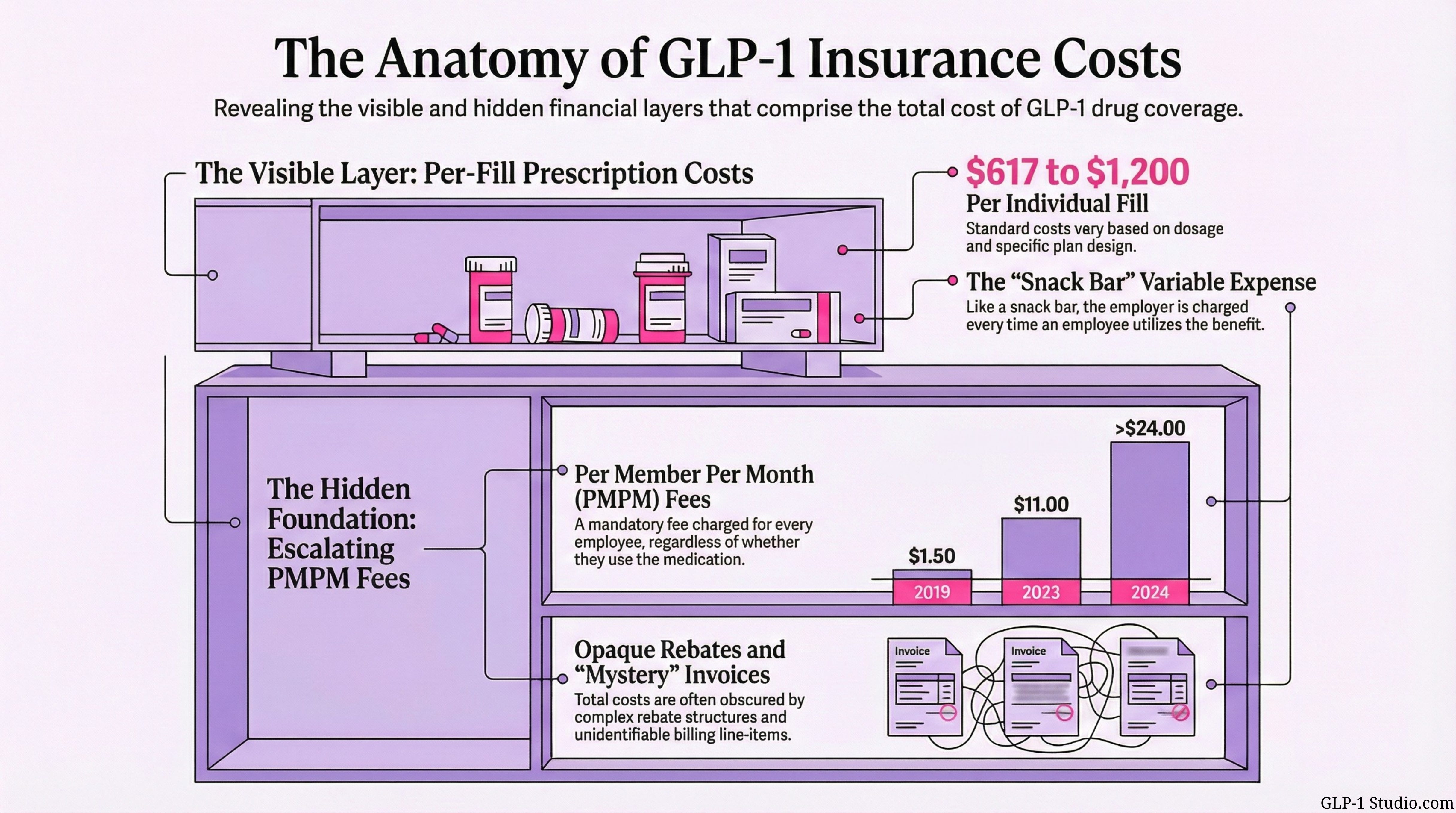
That is essentially how GLP-1 coverage works with traditional insurance.
For a company with a few hundred employees, that adds up extraordinarily fast regardless of how many people are actually on the medication.
GLP-1s went from #32 in pharmacy spending to #1 in a single year for one company, and another said they spent half a million dollars and were projected to hit $1.2 million the following year.
Research from the Employee Benefit Research Institute found that covering GLP-1s through insurance could raise employer premiums by as much as 14%, even when access was limited to the highest-need patients.
So employers were stuck.
Cover these medications and watch costs spiral with no ceiling in sight. Or drop coverage and devastate the employees who depended on it.
Most chose to drop it or never offered it at all. By 2025, only about 19% of companies with 200 or more workers were covering GLP-1s for weight loss.
GLP-1s — The Wellness Program Employees Want
Here’s the thing.
Employers have been spending money on wellness for years:
So the money is already being spent.
The question is what it is being spent on:
Weight Watchers memberships
Gym subsidies
Mental health apps
Step challenges
But here is what none of them can do: treat obesity as the biological disease it actually is.
Now look at what the research says actually happens when people get consistent access to GLP-1 medications.
An employer contributing $100 per fill through Andel is spending $1,200 per year on that employee’s GLP-1 access. That is less than what many companies are already spending on wellness stipends that cannot deliver those clinical outcomes.
And unlike a gym membership, there is no PMPM overhead, prior authorization process, or pissed off employees eating up HR time and budget.
Now imagine the new snack bar:
💵 The employer puts a set amount on your account each month.
💳 You pay what is left.
💰 No monthly overhead fee charged across people who are not even participating.
📃 AND a receipt showing exactly what everything cost
There’s no competition.
The Real Cost of Doing Nothing: Productivity, Morale, and the Talent You Are Losing
Let me put some numbers on the table that every HR director in America needs to see.
That is not a healthcare cost, that is a productivity cost:
Brain fog
Chronic fatigue
Joint pain that makes it hard to sit at a desk for eight hours
Sleep apnea that means someone shows up exhausted every single day
These are not problems employees leave at the door, they come to work with people.
The disability data alone tells the story.
Workers with obesity have roughly 76% higher short-term disability rates than their normal-weight colleagues, meaning every employee who gains stable access to effective obesity treatment is statistically far less likely to go out on disability leave.
Modeling research published in PMC shows that modest weight loss reduces annual healthcare spending by approximately 15% per person, with effects rising in patients with higher baseline BMI and more comorbidities.
And the Aon multi-year study found something even more striking: among patients who maintained consistent use, the rate of medical cost growth was cut roughly in half within two years.
As Aon’s own researchers put it, that is not just a win for patients. That is a win for employers, insurers, and the healthcare system as a whole.
For those who maintained consistent GLP-1 use, medical cost growth was six to nine percentage points lower compared to non-users, and female GLP-1 users saw a 47% reduction in hospitalizations for major cardiovascular events. Fewer hospitalizations means fewer emergency absences. Fewer emergency absences means more consistent, present, productive employees.
And then there is the question of loyalty:
Read that last one again. One in eight employees would hand back vacation days in exchange for GLP-1 coverage.
I know I would 🖐️
If you are an employer trying to compete for younger talent right now, that number belongs in your benefits strategy conversation immediately.
The inverse is equally true.
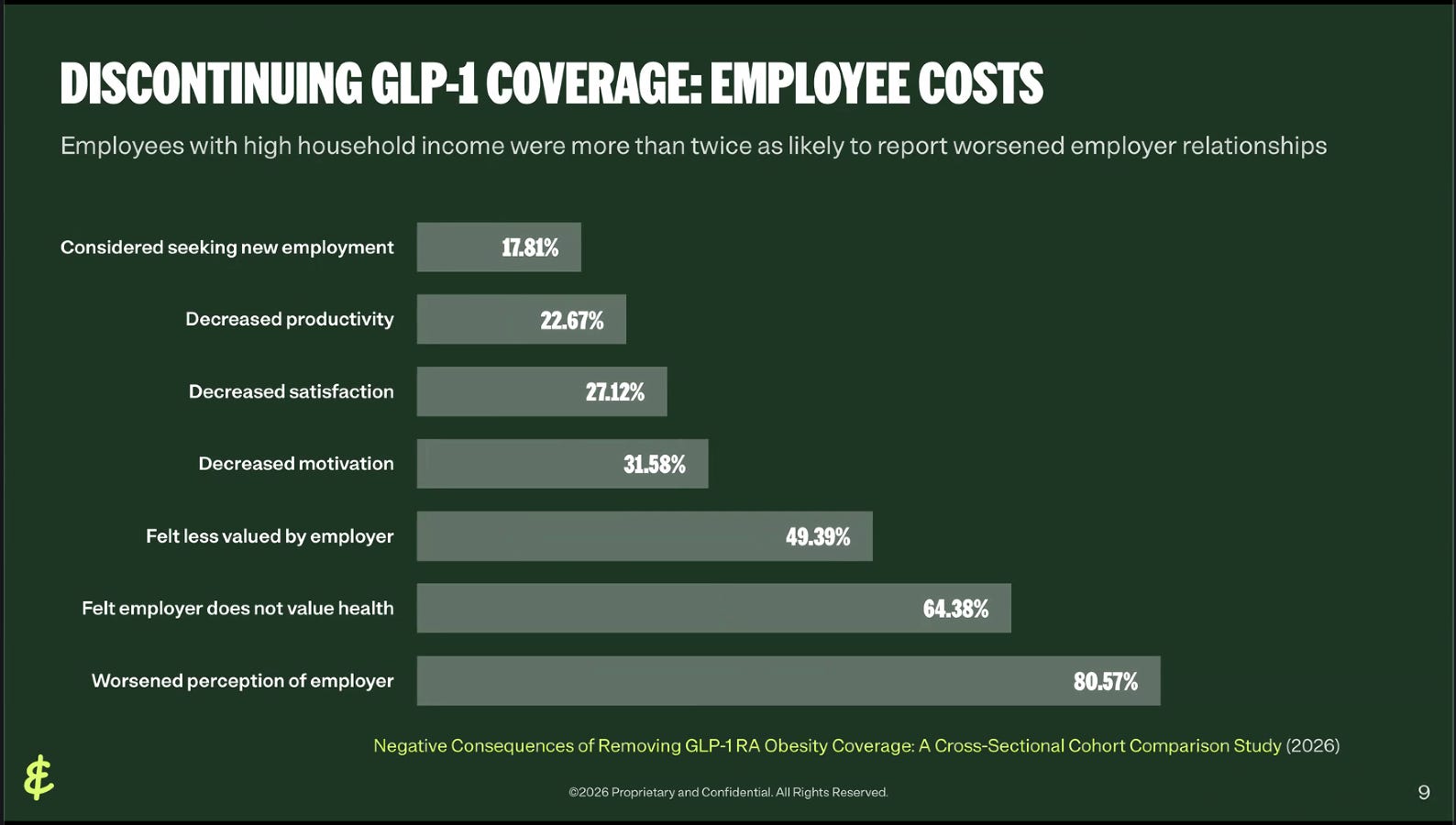
The study published in Obesity Science and Practice that Jay referenced in our conversation found that 81% of employees had a worse perception of their employer after losing GLP-1 coverage, and 18% considered finding a new job as a direct result.
That is not apathy. That is a workforce that is paying close attention to how they are treated. And in a labor market where replacing a single employee can cost up to 200% of their annual salary, the math on covering this medication starts to look very different very quickly.
Enter Andel.
What Is Andel?
Andel is a healthcare technology platform that enables high-cost medications like GLP-1s to be more accessible through employer benefits.
Jay Bregman, the founder and CEO, is a serial entrepreneur with 20+ years of experience building and scaling companies across mobility, insurance, and healthcare. He’s successfully exited three ventures, including Hailo (now Lyft Europe) and Thimble, which was acquired by S&P 500 insurer Arch.
At Andel, Jay is leading the development of an employer-supported medication marketplace improving access and affordability for GLP-1s and other breakthrough medications.
All this to say:
Andel helps employers offer these drugs as a workplace benefit to their employees at a more affordable cost.
Jay wanted to solve the biggest problem in healthcare: brand-name prescription pricing and distribution.
He got there by watching C-SPAN.
Specifically, the Senate hearings where pharmaceutical CEOs and PBM executives sat across from Bernie Sanders and everyone yelled at each other for three hours and absolutely nothing changed.
Jay looked at an $850 billion to $1 trillion prescription drug market growing at roughly 10% a year and thought: this is medieval. Someone should do better.
That someone was Jay.
He named Andel after a Danish and Swedish word meaning “a share” or “a part,” a reference to the member-focused cooperatives Scandinavia has been running for hundreds of years.
The idea is structural. You build the platform so the incentives push money toward the drug and toward the patient rather than into administrative overhead.
Andel built its own non-dispensing pharmacy and its own pharmacy management system from scratch, no legacy infrastructure, no inherited bloat.
The platform connects directly to SureScripts, the national prescription network. When a prescriber sends a prescription, the app handles it. No prior authorization request, step therapy appeal, or forced fail first attempts.
The medication ships next day via UPS with supplies included.
There are zero administrative fees or PMPM fees charged to employers. Whatever the employer contributes goes directly toward the cost of the medication.
Nothing disappears into overhead.
Eli Lilly’s Direct-to-Employer Platform
On March 5, 2026, Eli Lilly officially launched Lilly Employer Connect, a program giving employers a direct route to offer Zepbound to their employees at the $449 direct-to-employer price, completely outside the traditional insurance and PBM channel.
Those partners include:
Andel
9amHealth
Calibrate Health
Crux Health
eMed
FlyteHealth
Form Health
Goodpath
GoodRx
Ilant Health
Mark Cuban's Cost Plus Drug Company
Onsera Health
ReviveHealth
SALTA Direct Primary Care
Sesame
Teladoc Health
Transcarent
Waltz Health
Every option is different, from bare-bones third-party administrator services all the way to wraparound obesity management, lifestyle programs, and full telehealth services.
Andel is a cooperative model:
No PMPM fees
No administrative overhead
A membership fee under $10
An employer contribution structure that starts at $50 with no ceiling
It is built for employers who want maximum transparency and minimum overhead, and for employees who want a clear readable receipt and next-day delivery without a prior authorization fight in the way.
Andel is not a simple startup. It is a vetted partner inside a program that Eli Lilly built and launched specifically to solve this access problem.
Today, GLP-1 manufacturers are fully embracing this approach and working directly with vendors and employers to provide better access.
How Much Does Andel Cost?
Now for the part you’ve been so patiently waiting for, the cost.
Before your employer contributes anything:
Zepbound KwikPen ALL DOSES: $449.00
Shipping and handling, including 5 needles: $55.00
Andel membership fee: $9.99
Total all-in per fill: $513.99
Employers also have the option to cover the $9.99 membership fee on behalf of their employees.
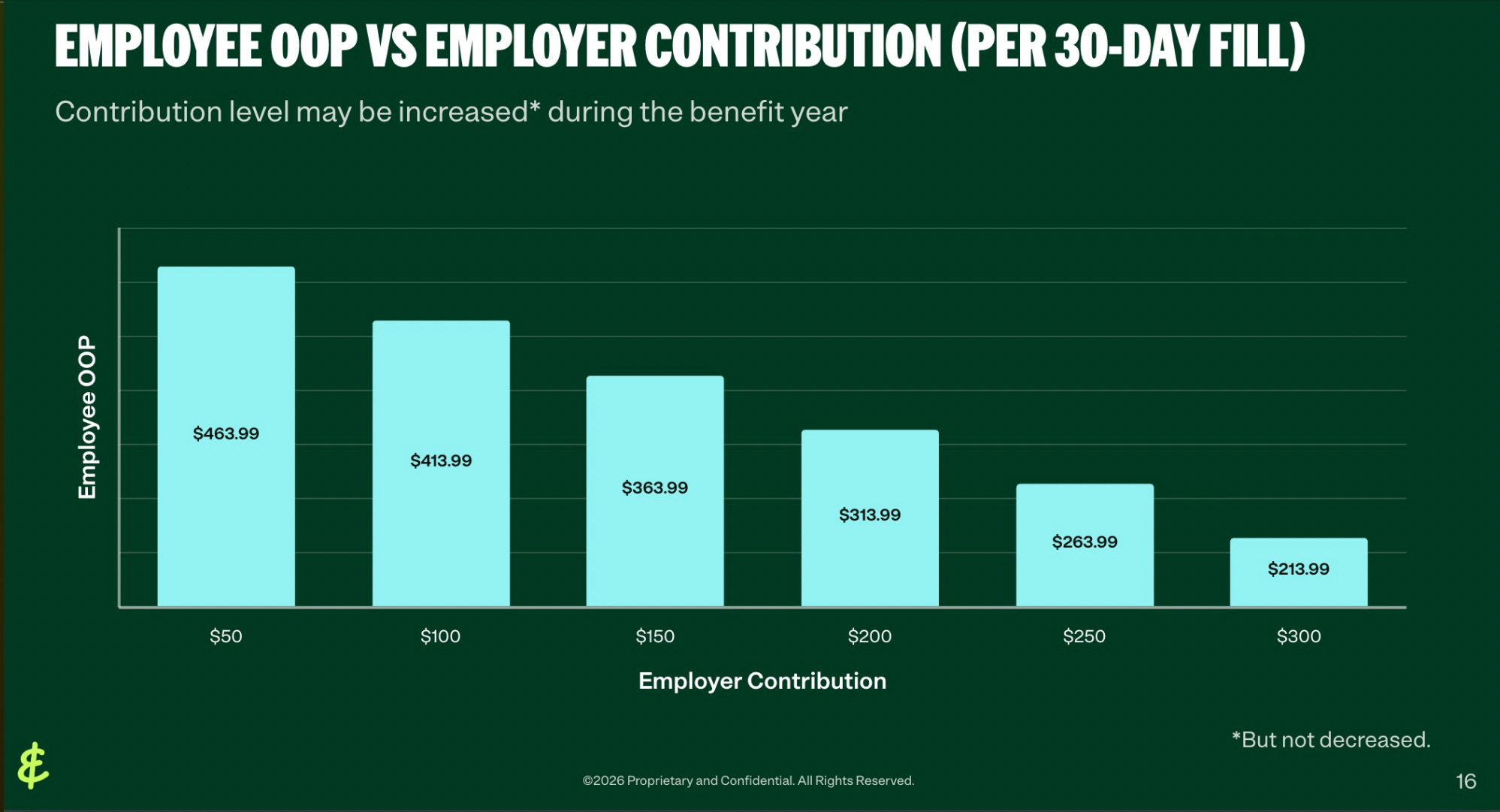
What you actually pay based on your employer’s contribution:
$50 employer → $463.99 employee
$100 employer → $413.99 employee
$150 employer → $363.99 employee
$200 employer → $313.99 employee
$250 employer → $263.99 employee
$300 employer → $213.99 employee
Lilly’s own cash pay price through LillyDirect runs $550 per month. Andel’s direct-to-employer price is already lower than that before your employer contributes a single dollar.
One important note: employer contributions can be increased during the benefit year but cannot be decreased.
Insurance vs Andel
Curious how Andel holds up to traditional insurance coverage?
See the difference for yourself:
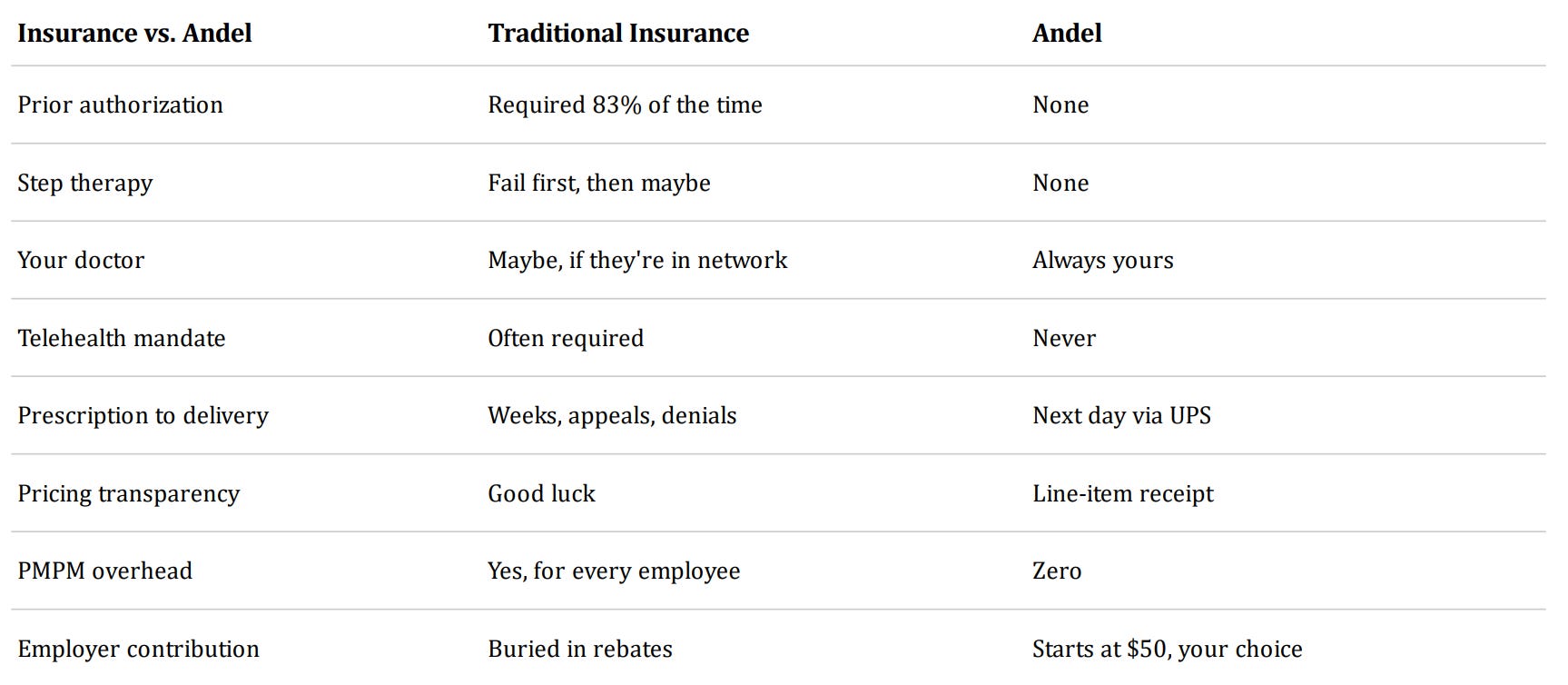
83% of commercial insurance plans require prior authorization, step therapy, or both before a patient can access a GLP-1 prescribed for obesity.
Your doctor writes the prescription, hands it to you, and the insurance company goes: actually, wait.
Have you considered failing at something cheaper first?
No?
Let’s start there.
Girl, please. 💅
And it’s not just frustrating. It is life threatening.
Andel was developed to fix those issues.
Don't Wait for HR to Figure This Out
You do not need HR to find this. You can send it to them yourself.
Here is how:
Go to andel.org/referral
Fill out the Refer Your Company form
Let Andel reach out to them directly
It takes 5 minutes to hand your employer a vetted Lilly partner with transparent pricing, no administrative overhead, and a cost structure that is cheaper than traditional insurance.
A note: Andel is currently operational in New York State. If you are outside New York, keep an eye out for their expansion.
That is self-advocacy in the most practical form it can take. And we all know that when you advocate for yourself, you advocate for all of us. 🌎💫

Find Andel: 🌐 andel.org 💼 Andel on LinkedIn 👤 Jay Bregman on LinkedIn


