

If you’ve ever felt like you “failed” after surgery… or after stopping a GLP-1… you’re not alone.
An entire system has been built around obesity “care” that expects people to succeed without the support they actually need, then blames them when it doesn’t work long-term.
Key Details:
Bariatric medicine and obesity medicine are essentially the same thing — both refer to the medical treatment of obesity.
Bariatric patients have had surgical intervention, while GLP-1 patients are managing obesity through medication — but both are treating the same chronic disease.
There are several types of bariatric surgeries including gastric sleeve, gastric bypass (Roux-en-Y), gastric band, duodenal switch (DS), and SIPS/SATY (single anastomosis procedures).
Bariatric surgery boosts the body's natural GLP-1 production, with the strongest effects in the first 12 to 18 months. Over time those hormonal effects can level off and some patients regain weight — in those cases, a GLP-1 medication can help.
Many private insurance plans already cover dietitian visits at no cost under Medical Nutrition Therapy benefits — call your insurance and ask about code 97802.
Steph Wagner, The Bariatric Food Coach
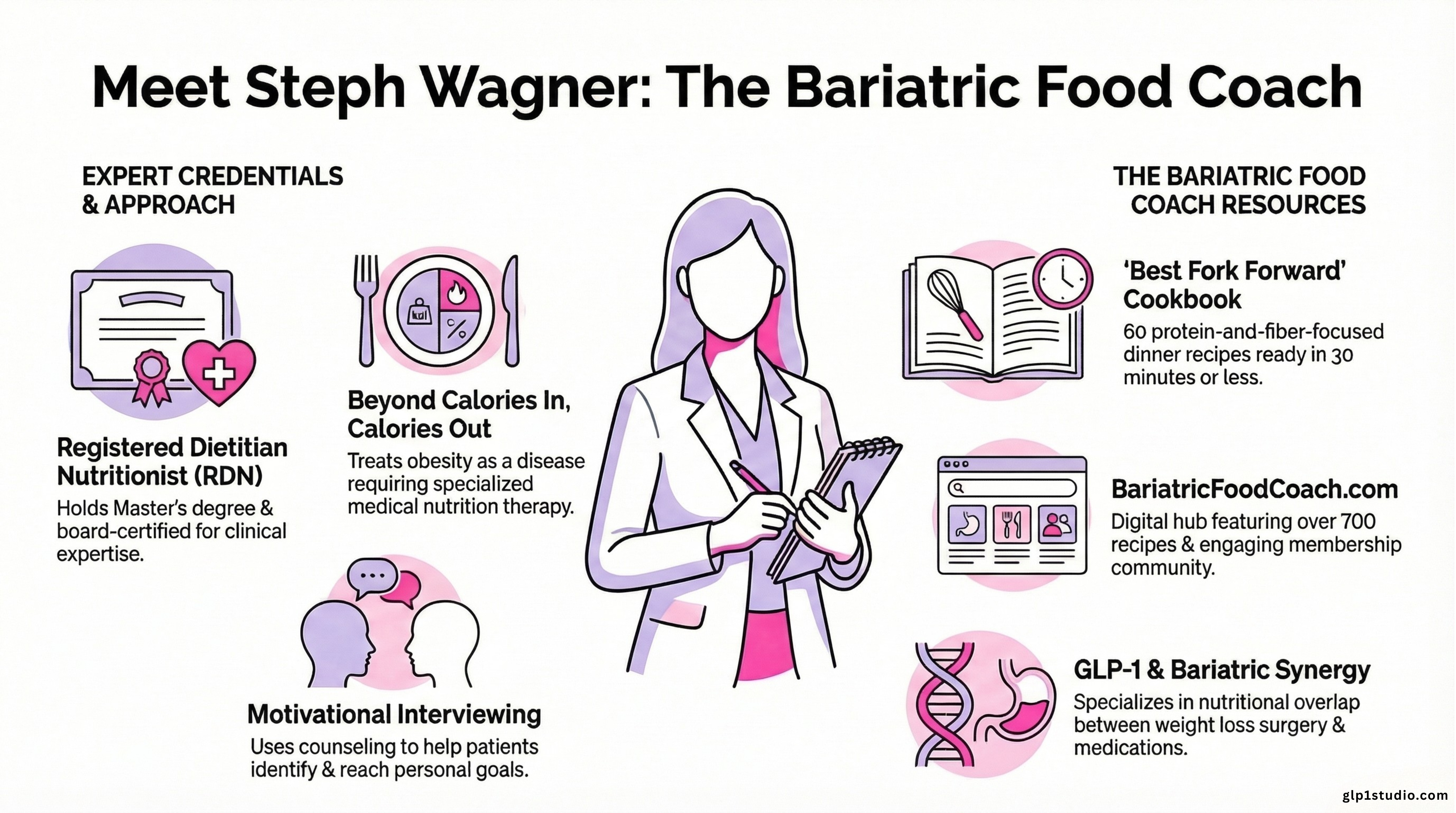
Stephanie Wagner, MS RDN, Dietitian, owner of the Bariatric Food Coach, and author of Best Fork Forward—has over 15 years of experience in this space.
Steph has been specializing in bariatric surgery patients since 2009.
Here is what she’s found so far:
Nutrition for bariatric patients and patients on GLP-1 medications is almost entirely the same.
Protein, fiber, habits.
Which makes sense, both are treatments for the same underlying disease.
And yes, obesity is a disease.
But before we get into the fascinating science, I want to take a moment to gush.
Obviously, Steph is impressive. “She’s done the things.” 😉
But what you don’t see when you read the letters after her name or look at the business she’s built is the incredibly radiant soul behind the work.

I don’t go this deep for every guest.
There are two people I have met in obesity care where I instantly thought, wow—if you could see auras, Steph Wagner and Dr. Lindsay Ogle, would outshine the sun.
Which is ironic since Dr. Ogle introduced us to begin with.
Disclaimer’s at the bottom of the article, but just to reinforce—I was not paid to say this, or to interview either of them. I genuinely feel it.Now back to the fascinating science.
What is Bariatric Surgery?
Steph explained that bariatric medicine and obesity medicine aren’t just basically the same, they’re literally the same thing.
The difference between bariatric and GLP-1 treatments is the tool. Bariatric patients have surgery, while GLP-1 patients use medication to manage the same chronic disease. Same disease, different tools.
But they are more alike than you think.
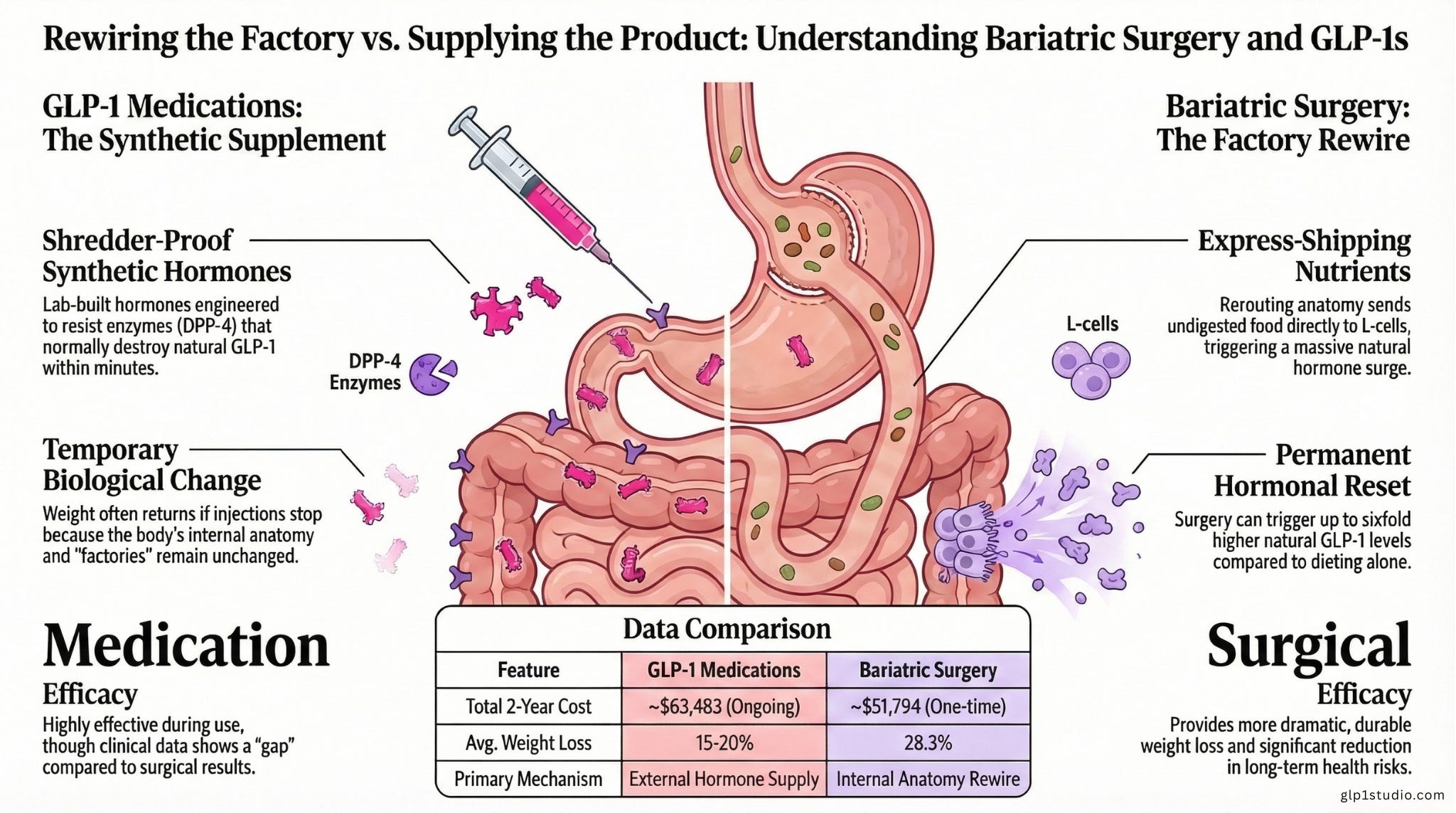
Bariatric surgery doesn’t just work by shrinking your stomach… It hijacks your hormones in the best possible way. Especially your natural GLP-1.
There are several different types of bariatric surgeries but they do not all work the same way.
Gastric sleeve 🍌
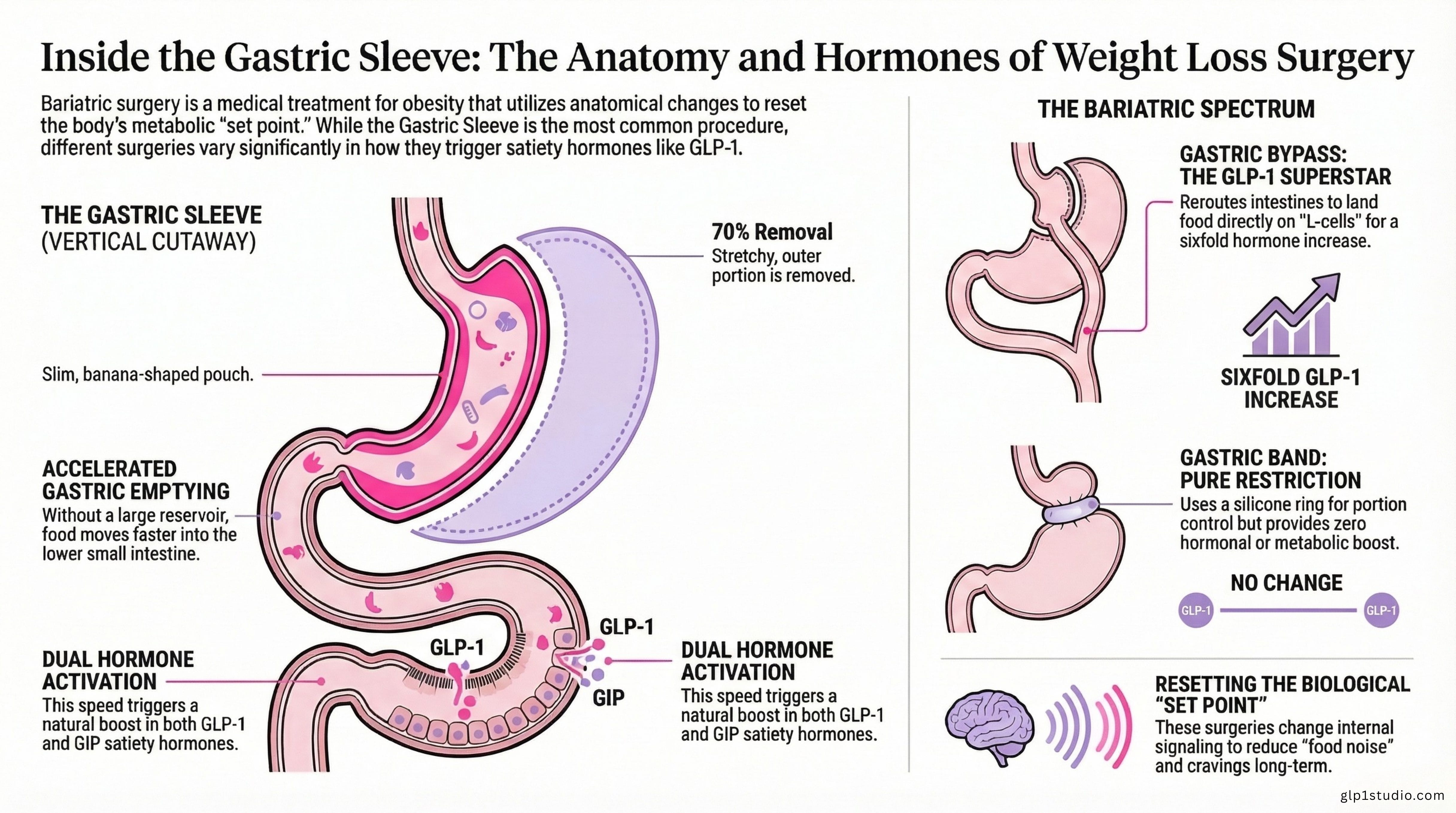
Removes the stretchy part of the stomach, that expands like a balloon to hold your meal while it slowly releases. With 70% of your stomach gone what’s left is the shape of a banana, that can’t really “hold” food anymore, so it pushes through way faster.
How it affects natural GLP-1:
The part of your intestines that makes GLP-1 only turns on when food actually hits it.
L-cells are tiny “food sensor” cells in your lower intestine that release GLP-1 when food hits them.
So when food shows up faster and in bigger chunks, L-cells in the lower intestine go into overdrive and pump out more GLP-1 than they did before surgery.
Food moves faster → hits the gut sooner → more GLP-1 gets releasedThis is a big reason people feel fuller and less hungry after surgery. But here’s what makes the sleeve special. It doesn’t just boost GLP-1. It also boosts GIP.
K-cells are the “food sensor” cells that make GIP, and they mostly live in the upper part of your intestine.
Sleeve = GIP ↑↑ + GLP-1 ↑↑Your intestines are still in their normal layout so food passes through both hormone “zones,” giving you a two-for-one effect.
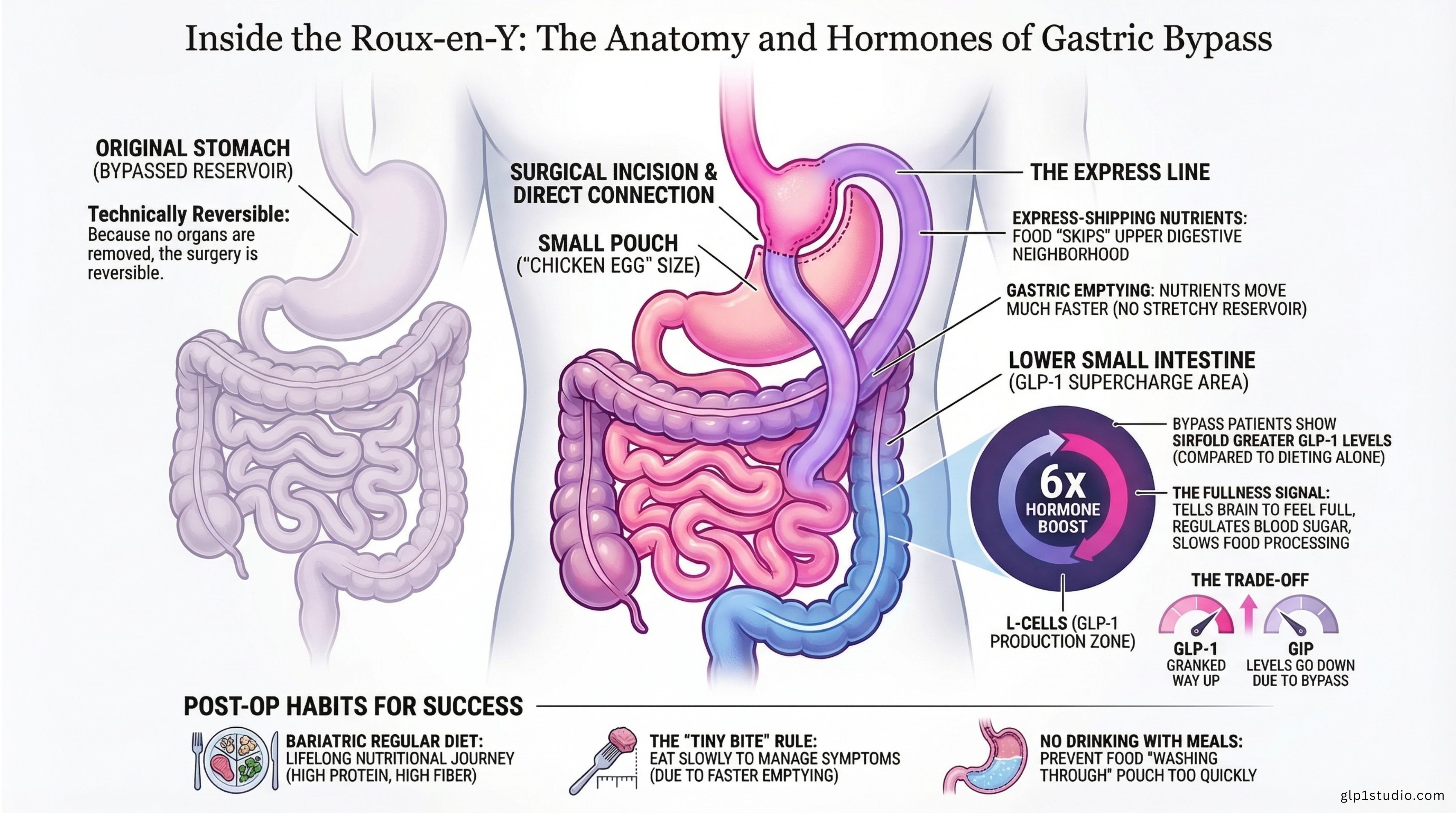
Gastric bypass (Roux-en-Y) 🥚
Shrinks the stomach down to about the size of a small egg and then reroutes part of the small intestine to connect directly to that tiny pouch.
How it affects natural GLP-1:
Food literally skips about 95% of the intestine and lands directly where L-cells are packed the densest. It's like express-shipping a package of undigested nutrients straight to the GLP-1 production line.
A review in Endocrinology found that bypass patients had 6x greater GLP-1 levels compared to people who lost the same amount of weight through dieting alone.
That’s how we know this isn’t just a weight loss thing. It’s an anatomical rearrangement thing.
Bypass = GLP-1 ↑↑↑ + GIP ↓Interestingly, GIP is greatly reduced because food completely skips the place that produces it.
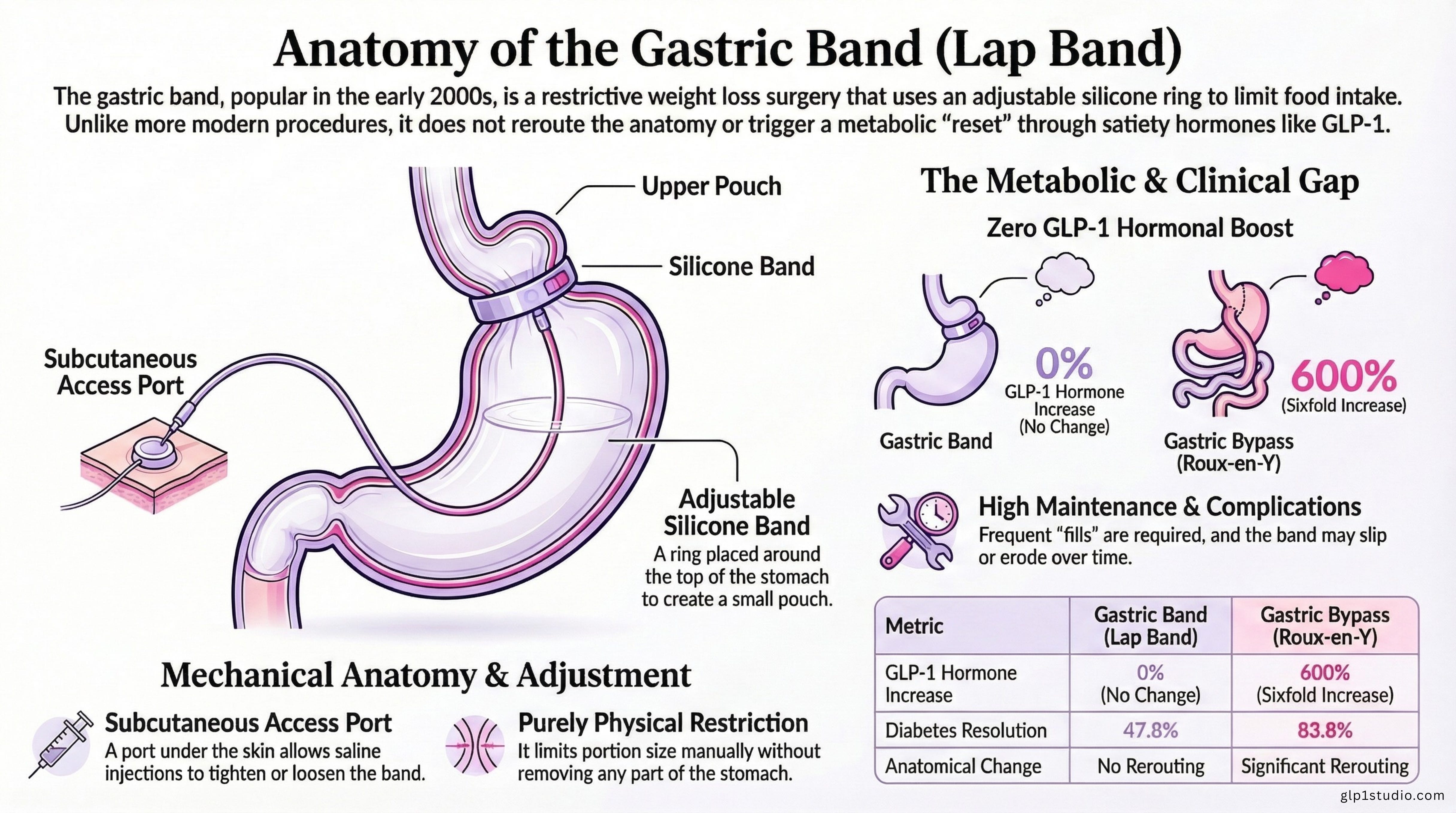
Gastric band (lap band) ➰
An adjustable silicone band wrapped around the top of the stomach to create a tiny pouch above it. Nothing gets removed. Nothing gets rerouted. You just physically can't fit as much food in at once.
How it affects natural GLP-1:
It doesn’t.
The band is purely mechanical. If GLP-1 production depends on food reaching L-cells in the lower intestine faster and in bigger amounts, and the band doesn’t change anything about how fast food travels through your system, there’s no reason for those L-cells to behave any differently than before.
Band = GLP-1 → + GIP →It works on pure portion control and nothing else. No hormonal help, no metabolic reset.
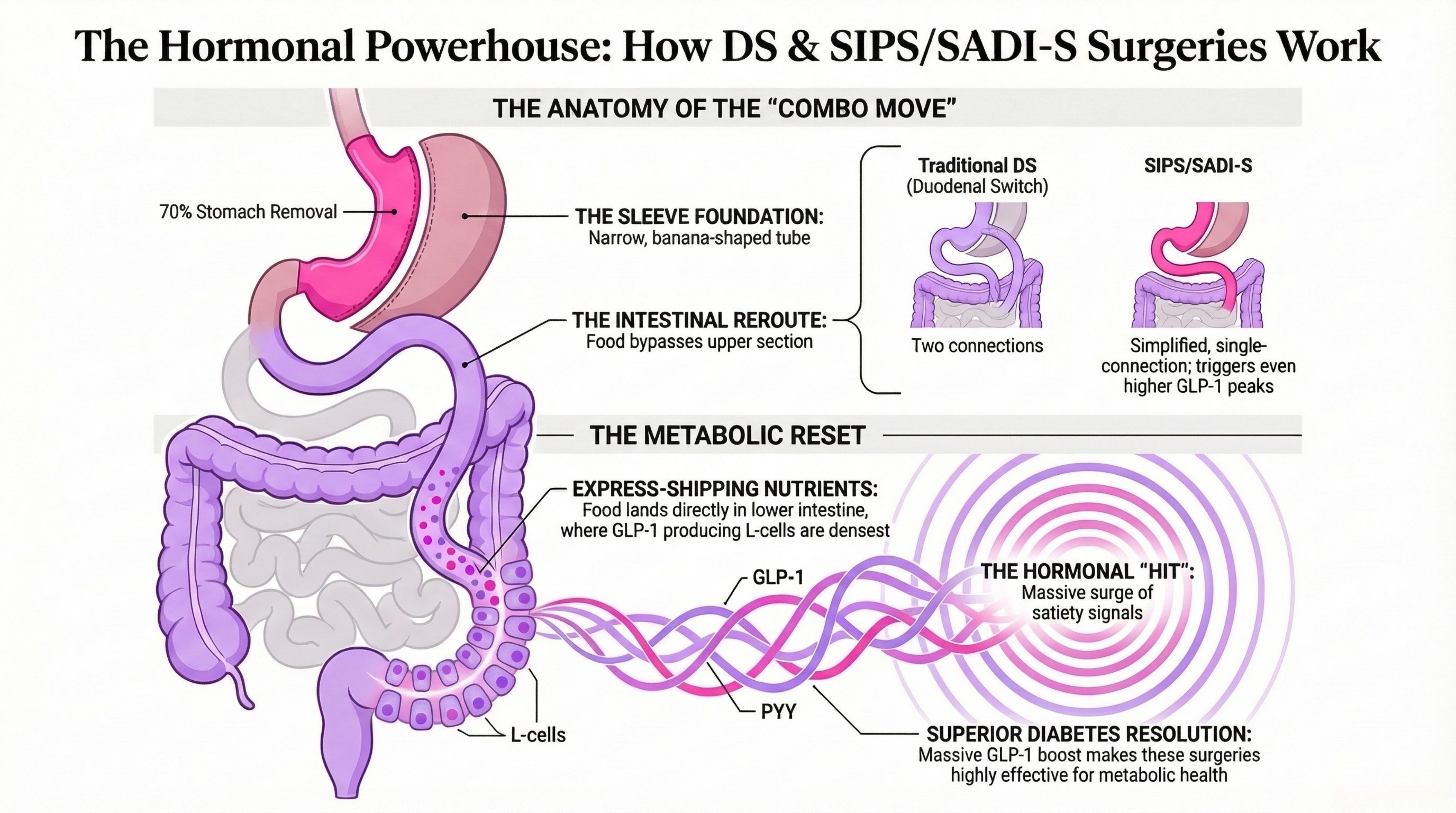
DS (duodenal switch) and SIPS/SADI-S
Starts with a full sleeve, removing about 80% of the stomach. Then the surgeon separates the intestine just past the stomach and reconnects it lower down.
The valve at the bottom of the stomach stays in place and still works normally. Food leaves the stomach the usual way, it just gets redirected to a lower part of the intestine after that.
Traditional DS (BPD-DS)
Traditional duodenal switch has two intestinal connections. The surgeon does the sleeve, then reroutes things in two places so food and digestive juices travel separately.
SADI-S/SIPS
SADI-S is the same basic idea but with just one connection. Everything flows through a single channel, making it a simpler, lower-risk surgery.
How they affect natural GLP-1:
Because you’re getting both the sleeve effect (faster emptying from losing the stretchy part of the stomach) AND the bypass effect (food landing directly in L-cell territory), these procedures create the most dramatic hormonal changes of any bariatric surgery.
Duodenal switch, makes GLP-1 go way up, and since food skips the part of the intestine where GIP is made, like bypass, GIP is reduced.
DS (BPD-DS) = GLP-1 ↑↑↑ + GIP ↓↓ But here’s where it gets wild. A head-to-head study found that SADI-S actually leads to higher GLP-1 levels after eating than the traditional DS.
SADI-S/SIPS = GLP-1 ↑↑↑↑ + GIP ↓↓So mechanistically they’re doing the same thing (sleeve + bypass of upper intestine), but SADI-S does it with one connection instead of two, and somehow gets an even bigger hormonal response.


Bariatric Surgery vs GLP-1 Medications
It all comes down to how much the surgery changes the path food takes.
The more things get rerouted, the bigger the hormone response:
Band barely changes anything and doesn’t do much hormonally
Sleeve speeds things up and gives a moderate boost
Bypass sends food straight to the GLP-1 zone for a bigger effect
DS/SADI-S basically does everything at once and hits the hardest.
Bariatric surgery and GLP-1 medications are not rivals.
Surgery is especially effective in that first 12 to 18 months, in part because it dramatically increases your body’s natural GLP-1 levels. That’s actually how scientists figured out GLP-1 mattered in the first place, and eventually turned it into medication.
Surgery changes your body to help it make more GLP-1
Medication gives you a synthetic version to help boost levels
And when that natural boost from surgery starts to fade, meds can step in and keep things going.
You Did Not Fail Your Treatment
The hormone boost from bariatric surgery doesn’t last forever for everyone. GLP-1 levels spike right after surgery, hit their peak in the first year or two, and then slowly start to fade.
Around year two is when some people start to see weight come back, and by year three, more people are turning to GLP-1 meds. This doesn’t mean surgery failed. It just means the body adapted, and adding medication is simply continuing what the surgery started.
I have met so many people who carry deep shame about gaining weight back after surgery, or stopping a GLP-1.
Steph put it in a way that hits home:
“If we truly viewed obesity as a chronic disease… then bariatric surgery and GLP-1 medications are treatments, not tests you pass or fail.” —Steph Wagner
Obesity is a chronic disease, and chronic disease needs lifelong treatment.
You wouldn’t tell someone with cancer they “failed” because chemo didn’t work the first time. Just like you wouldn’t tell someone doing IVF that they failed if they couldn’t get pregnant.
But when it comes to weight, it gets personal.
Weight regain is not a failure of willpower. It is not a character flaw.
It’s your biology working against you. The hormone boost from surgery fades. The medication only works while you’re on it. None of that is a moral failure. It’s science.
And needing extra support is nothing to be ashamed of.
The Bariatric Food Coach
If you watched this episode and fell in love with Steph as much as I have, you can find her at @bariatricfoodcoach on Instagram, YouTube, Facebook, and Pinterest.
You can find her book Best Fork Forward on Amazon with: 60 high-protein, quick recipes designed for bariatric patients that apply directly to GLP-1 patients.
Steph did not pay for this episode or ask me to promote the book. I am recommending it because it is awesome. I mean a cookbook with a picture for every recipe? Yes, please! What’s more? She cooked every recipe and took every picture herself.
Just amazing…
On top of all of that Stephanie has built something genuinely useful over at bariatricfoodcoach.com:
Nearly 700 recipes
An AI chatbot where you can tell it what is in your fridge and ask it to build you a dinner
A GLP-1 video course
There is a Premier Access Membership starting at $19/month (HSA/FSA eligible) that unlocks every resource on the site: protein-focused recipes, education, and access to a community of bariatric and GLP-1 patients.
Her community has been active since 2015, which tells you something about whether it works.
I am excited and honored to share that I will be a guest speaker, on self-advocacy, for them on March 27th at 12pm CST, so it’s the perfect time to sign up.
I hope to see some of you there! 🥰


