

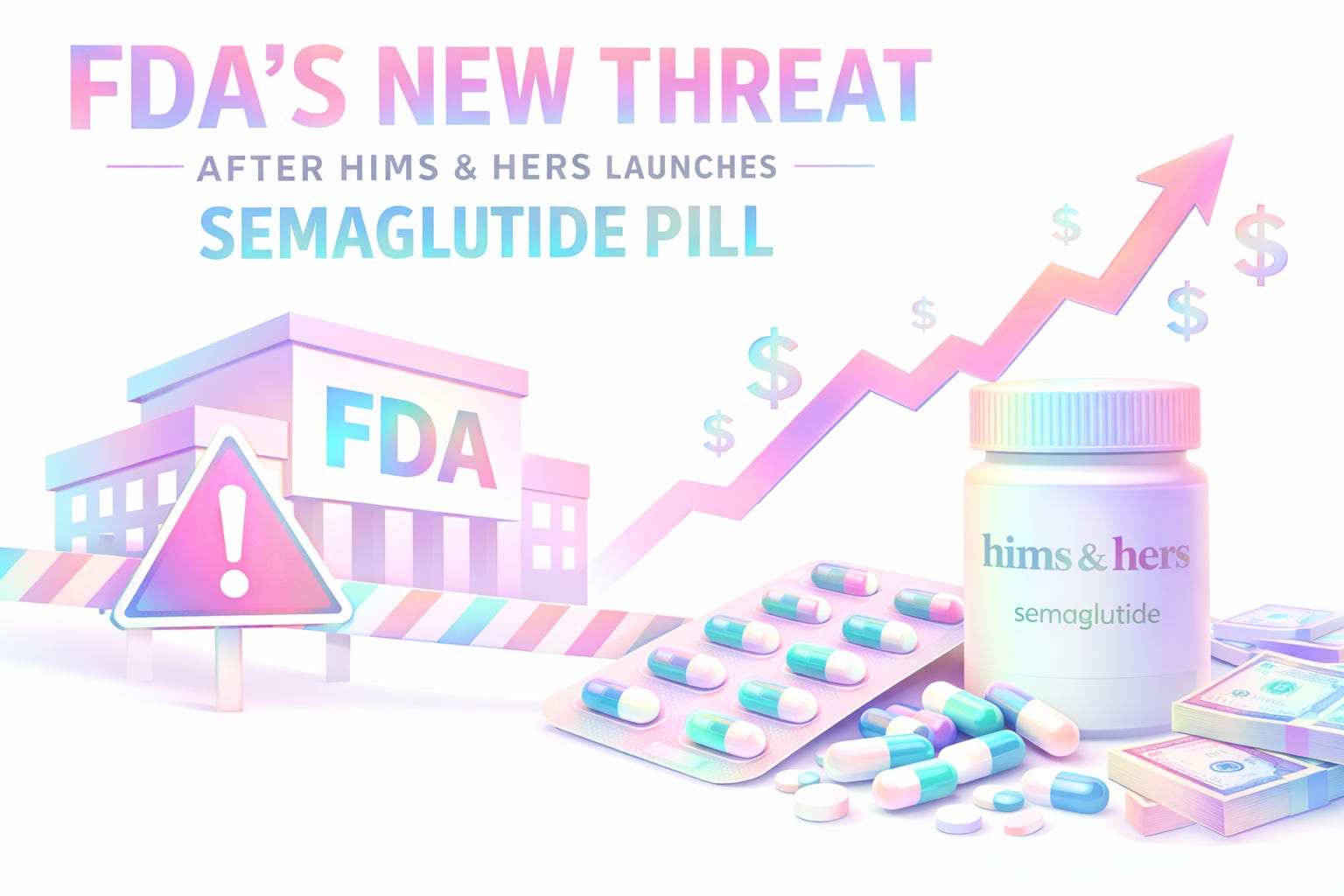
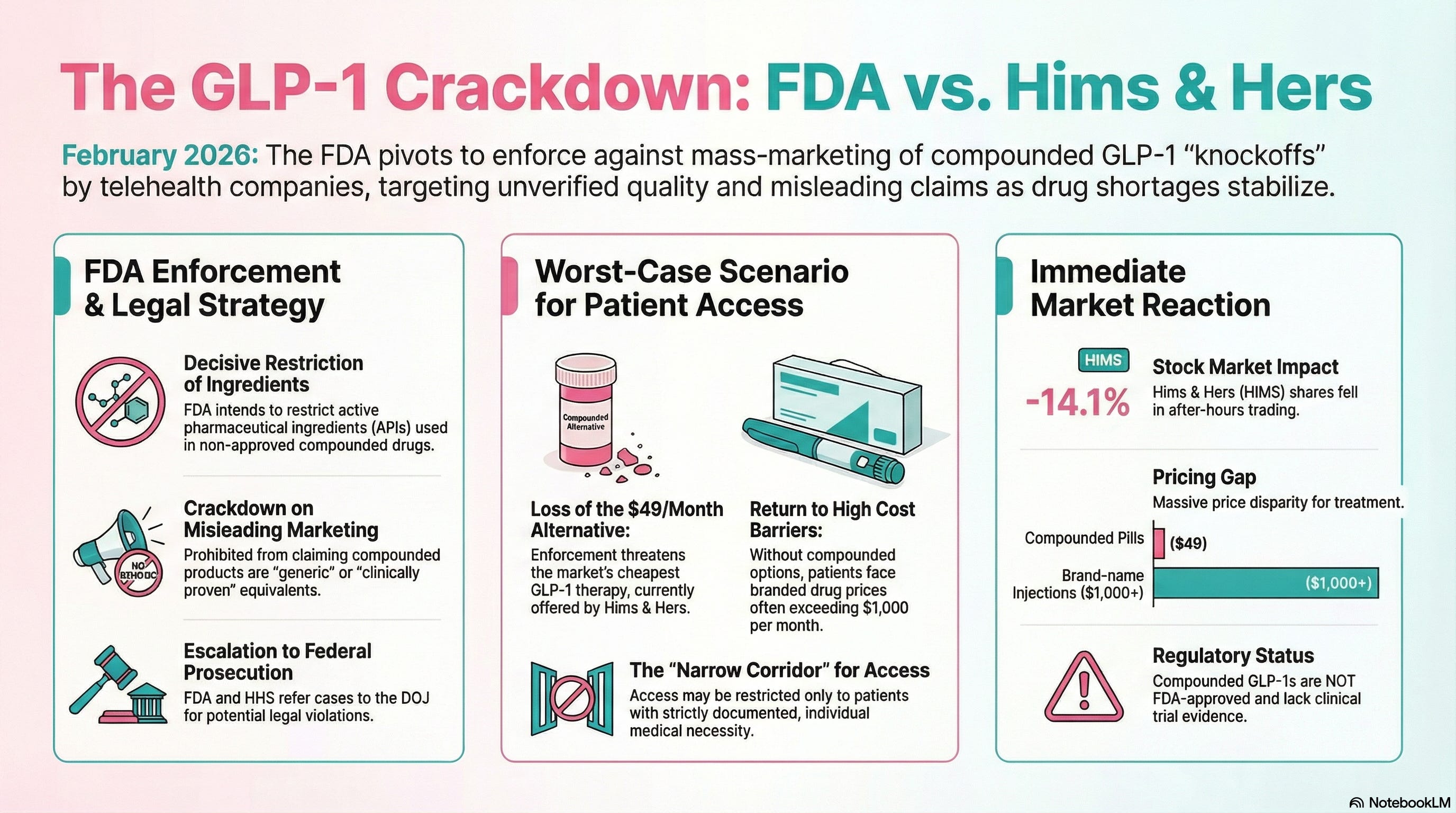
On February 6, 2026, the FDA announced it intends to take “decisive steps” to restrict GLP-1 active pharmaceutical ingredients (APIs) that are being used in non-FDA-approved compounded drugs.
Key details:
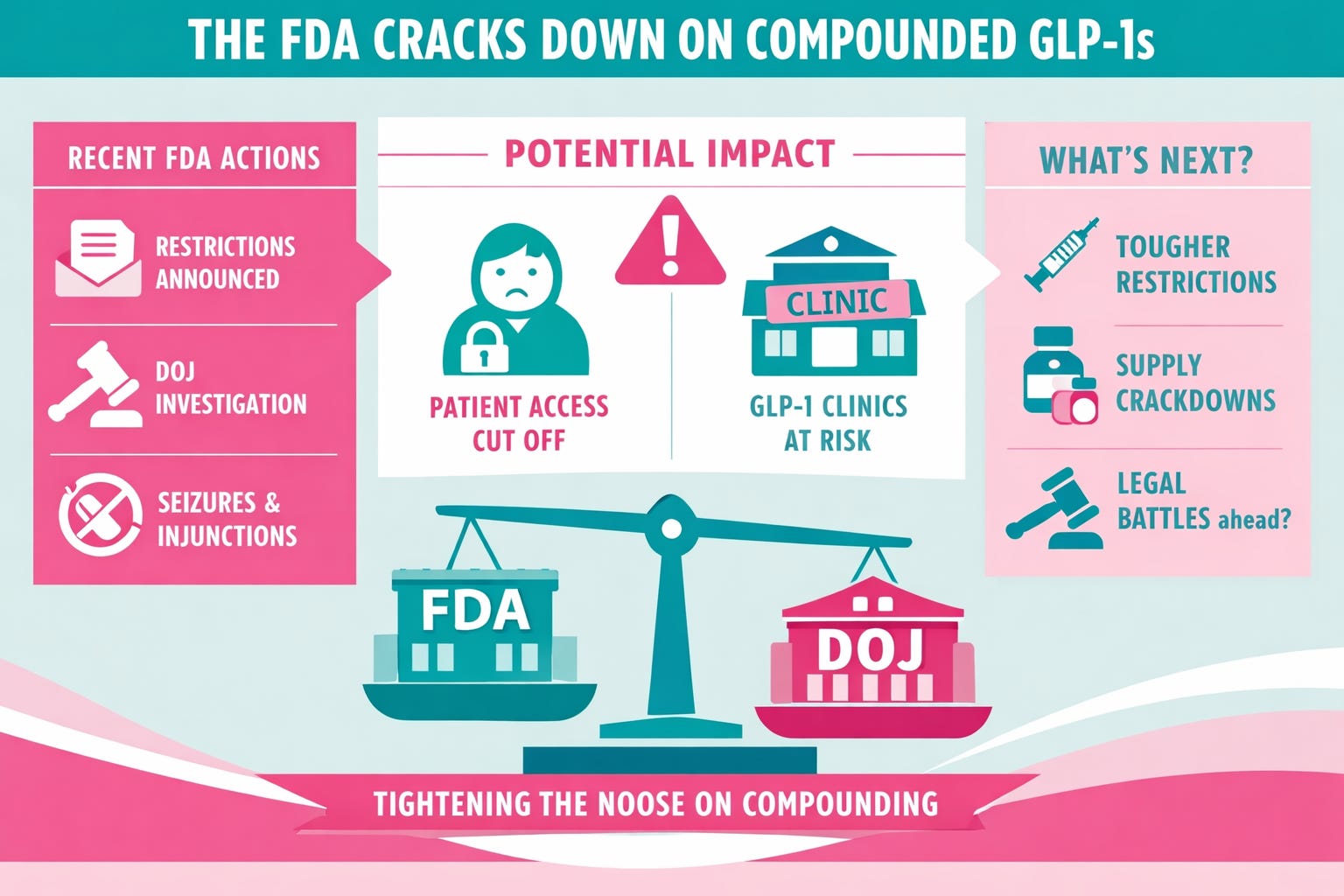
FDA will use “all available compliance and enforcement tools” including seizures and injunctions
Companies can no longer claim compounded products are generic versions, contain the same active ingredient, or are clinically proven
DOJ now investigating Hims for potential federal law violations
Enforcement priorities include: compounding without documented medical necessity, misleading marketing, poor API sourcing, and use of research-grade ingredients
Hims stock crashed 50% this year, down from $68 to below $17
The “regulatory gray space” that existed in 2024 has collapsed into “a tightly policed corridor” by 2026
What Happened With Hims & Hers and the FDA
Hims crossed a major line by trying to copy Novo’s oral Wegovy pill, which uses a special patented absorption technology called SNAC (salcaprozate sodium) to protect semaglutide as it passes through the digestive system.
Hims claimed they could replicate SNAC using “liposomal technology,” but there are literally no publicly available human trials showing that works on semaglutide.
Former FDA Commissioner David Kessler straight up told The New York Times:
And get this, he added that a 2mg compounded semaglutide pill may not act anything like its brand-name counterpart, with absorption off by upward of 30%, meaning one pill will have little effect while another will overdo it, meaning that you literally can’t know ahead of time what you’re getting…
Former FDA Commissioner Scott Gottlieb pointed out on CNBC:
This means that Hims wasn’t just compounding, they were essentially creating an entirely new unapproved drug.
Gottlieb also noted that the FDA typically takes administrative steps before escalating to the DOJ, suggesting the agency may be eager to go to court and secure a ruling against Hims.
So the FDA got mad. Hims wasn’t playing by any of the traditional compounding rules, they were trying to innovate around patented technology, mass-market it as equivalent to the FDA-approved version, and do it all without any clinical trials proving their version actually works.
It was basically regulatory arrogance on steroids, and the FDA made an example out of them.
In my opinion the FDA had no choice but to act. Hims kicked the hornets nest and the rest of us may potentially get stung.
What the FDA Actually Said They’ll Do
Here’s where it gets real for all of us, the FDA says it will use “all available compliance and enforcement tools” to address violations, which explicitly includes seizure and injunction.
Translation: they’re not messing around anymore.
Specifically, they’re planning to:
Restrict API access, this could potentially cut off the supply chain at the source.
Crack down on marketing claims, companies can’t claim their compounded products are generic versions, the same as FDA-approved drugs, contain the same active ingredient, or are clinically proven.
Go after “mass compounding,” meaning those without documented medical necessity, unlicensed manufacturing, improper storage and shipping, poor API sourcing, and use of research-grade ingredients.
This confirms that the remaining pathway to compounded GLP-1s is narrow, technical, and heavily scrutinized.
The Worst Case Scenario for Patient Access
Okay, let me paint you the absolute nightmare scenario, because I think we need to be realistic about what could happen:
If the FDA actually follows through on restricting API access, this would essentially end the ability of compounding pharmacies to create these medications.
Most of the accessible, affordable compounding options disappear.
If other telehealth companies face similar pressure and lawsuits as Hims & Hers, they may just... fold. And then where does that leave patients?
If DOJ starts bringing criminal charges or massive civil penalties against compounders, the chilling effect will be immediate and brutal. Nobody’s going to risk federal prosecution to provide affordable medication.
Regulatory tolerance began to collapse under manufacturer pressure and federal scrutiny. This isn’t just about one company or one product. This is the FDA drawing a line in the sand for the entire compounding industry.
The absolute worst case?
Potentially 1.5 million Americans who are currently using compounded GLP-1 drugs suddenly losing access to life-changing medication and getting forced off treatment entirely because they can’t afford brand prices and can’t access insurance coverage.
What’s your take on all this? Are you seeing panic just yet? Or are we all traumatized by last years “will we get cut off today or wont we” roller coaster?