

FEDERAL (Congress)
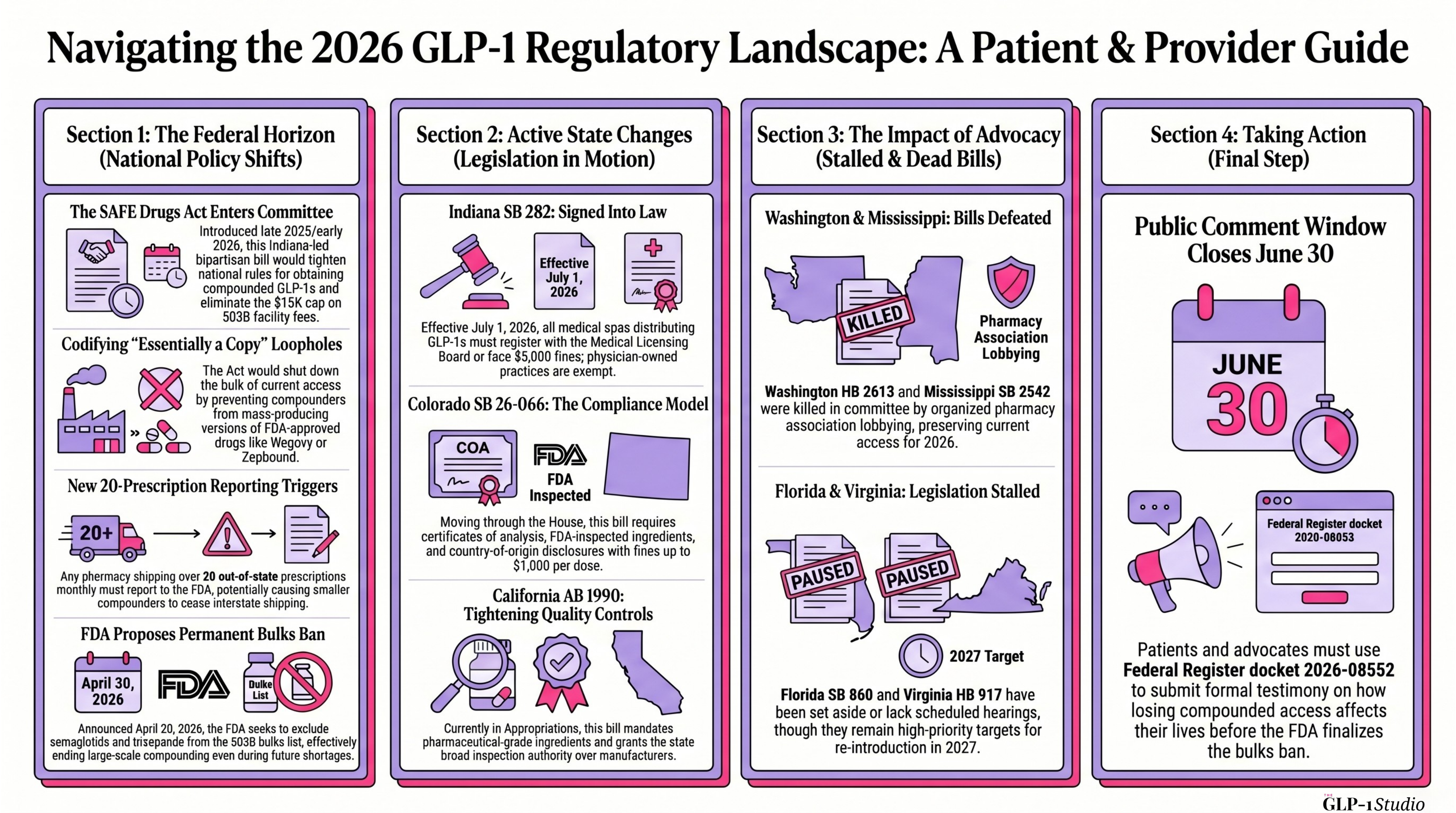
SAFE Drugs Act sits in committee The Safeguarding Americans from Fraudulent and Experimental Drugs Act was introduced in the House on December 9, 2025 and the Senate on February 5, 2026. Both versions still in committee, no hearings scheduled. Patient impact: No immediate change. But if this moves, the rules for getting a compounded GLP-1 anywhere in the country tighten significantly. Watch this one closely.
Codifies "essentially a copy" Would close the loophole letting compounders mass-produce versions of FDA-approved drugs. Patient impact: Most compounded GLP-1s in circulation today qualify as essentially copies of Wegovy or Zepbound. This provision alone would shut down the bulk of current compounded access.
20-prescription reporting trigger Any pharmacy shipping more than 20 out-of-state prescriptions of a single drug per month would have to report to FDA. Closes a major reporting gap on 503A facilities. Patient impact: Smaller compounders may stop shipping out of state entirely to avoid the reporting burden. Patients in states without local compounding pharmacies could lose their supply chain overnight.
Pre-inspection for 503B products Outsourcing facilities would have to be inspected before starting on any new compounded drug. Biennial reinspections required for facilities making more than 100 products per year. Patient impact: Adds delay to any new compounded GLP-1 entering the market. Patients waiting on compounded versions of newer drugs like orforglipron would wait longer.
$15K base fee cap eliminated HHS would get authority to set 503B establishment fees at whatever amount it considers appropriate. Patient impact: Higher facility fees get passed down to patients. The cost advantage of compounded GLP-1s over brand-name shrinks or disappears.
Public comment closes June 30 Federal Register docket 2026-08552. Citation: 91 Fed. Reg. 23431. This is the window for patients and advocates to weigh in. Patient impact: This is one of the few formal channels patients have to tell FDA what losing compounded access actually does to real lives. If you've ever benefited from compounding, this is the moment to say so on the record.
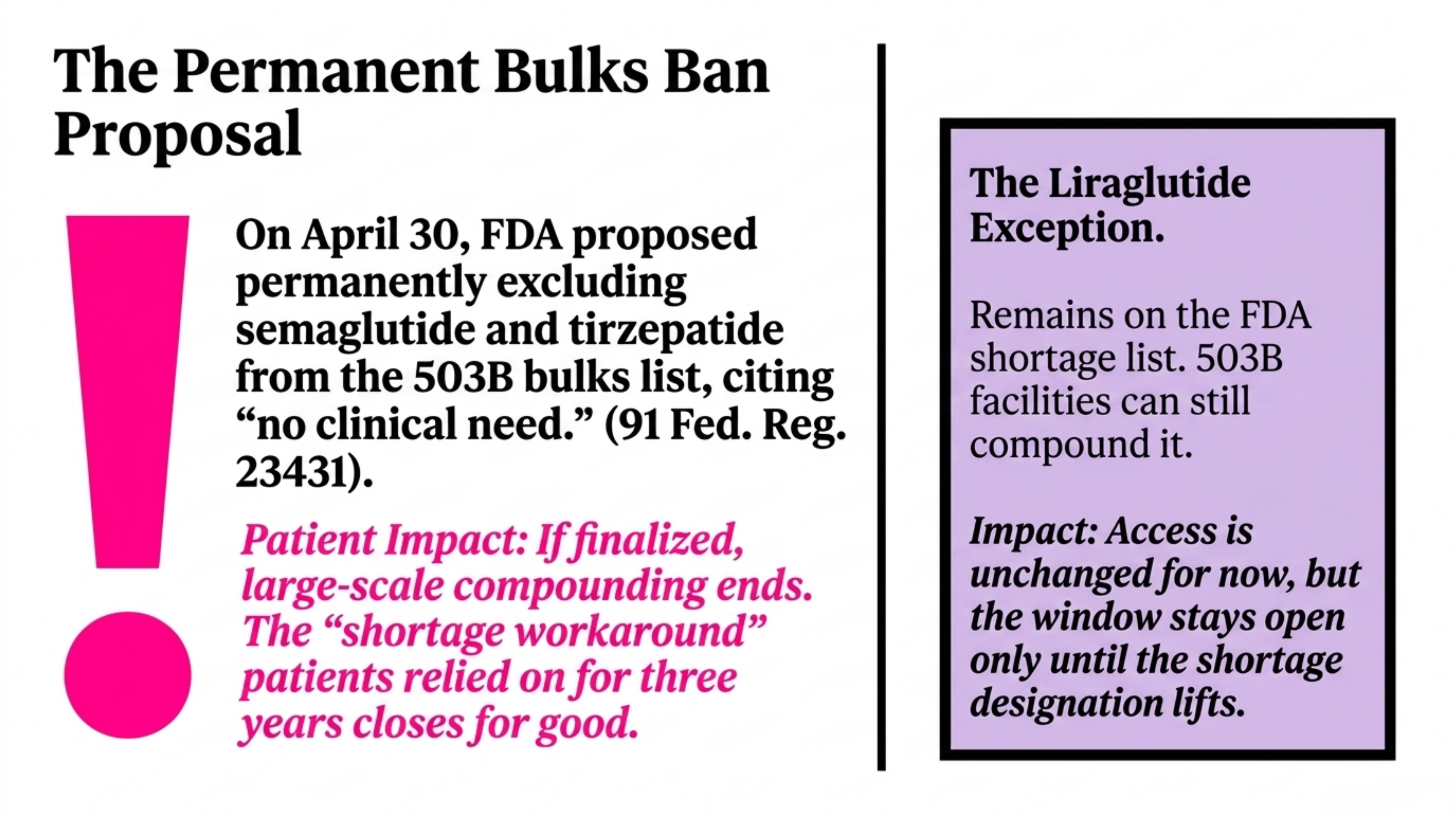
Liraglutide is the exception, for now Liraglutide remains on the FDA shortage list, which means 503B outsourcing facilities can still compound it under shortage rules even though it is on the proposed exclusion list. Patient impact: If you are on a compounded liraglutide product, your access has not changed yet. That window stays open only until the shortage designation lifts.
Bipartisan, Indiana-led Reps. Yakym (R-IN) and Carson (D-IN) wrote the House bill. Sens. Banks (R-IN) and Heinrich (D-NM) carry the Senate companion. Original House co-sponsors include Reps. McGuire (R-VA), Vindman (D-VA), Moran (R-TX), and Ross (D-NC), with additional co-sponsors added in early 2026. Patient impact: Bipartisan bills move faster and farther than partisan ones. Treat this as a real possibility, not a long shot.
Federal (FDA)
FDA proposes permanent bulks ban On April 30, FDA proposed permanently excluding semaglutide, tirzepatide, and liraglutide from the 503B bulks list on a finding of “no clinical need.” Patient impact: This is the big one. If finalized, large-scale compounding of these three GLP-1s ends, even if a future shortage hits. The “shortage workaround” patients relied on for three years is closed for good.
Safety data drives the FDA case Over 455 adverse event reports tied to compounded semaglutide and over 320 to compounded tirzepatide as of early 2025, many involving multidose vial dosing errors. Patient impact: Patients using properly-compounded GLP-1s from reputable licensed pharmacies are losing access because of bad actors and dosing-error patterns elsewhere in the system. The safe compounders pay the price along with the rest.
STATE: WHAT'S ACTIVELY MOVING
Indiana SB 282: SIGNED INTO LAW Signed by Governor Mike Braun on March 5, 2026. Most provisions take effect July 1, 2026. Medical spas distributing GLP-1s must register with the Indiana Medical Licensing Board by January 1, 2027. Fines reach $5,000 per unregistered site. Authored by Sen. Ed Charbonneau, with Rep. Brad Barrett carrying it in the House. Senate vote: 47-1. Notably, the bill exempts physician-owned practices. Patient impact: Indiana patients lose access to GLP-1s through unregistered med spas. The trade-off is more accountability for the spas that stay in the market. Net effect: fewer providers, better-regulated ones.
California AB 1990: IN APPROPRIATIONS Now in the Assembly Appropriations Committee after passing the Assembly Business and Professions Committee 17-1 on April 14. Author: Asm. Mike Gipson. Requires pharmaceutical-grade ingredients with certifications, manufacturer verification, recordkeeping, and inspection authority. Fines up to $1,000 per dose plus license revocation. Patient impact: California patients should expect fewer compounding options and higher prices on what remains. Some out-of-state compounders will simply stop shipping to California rather than comply.
Colorado SB 26-066: PASSED SENATE, NOW IN HOUSE Passed the Colorado Senate on April 17, 2026 with a 20-15 vote and moved to the House. Requires certificates of analysis, FDA-inspected ingredient sources, label warnings, and country-of-origin disclosure. Fines up to $1,000 per dose. The Attorney General can also enforce as a deceptive trade practice. Sponsored by Sens. John Carson and Iman Jodeh, with Rep. Jamie Jackson carrying it in the House. Patient impact: Colorado patients face new paperwork requirements and likely higher prices on compounded GLP-1s as pharmacies absorb the compliance costs. If it passes the House, this becomes a model other states will reach for.
STATE: WHAT STALLED OR DIED
Patient advocates and compounding pharmacy lobbying killed several bills before they could become law.
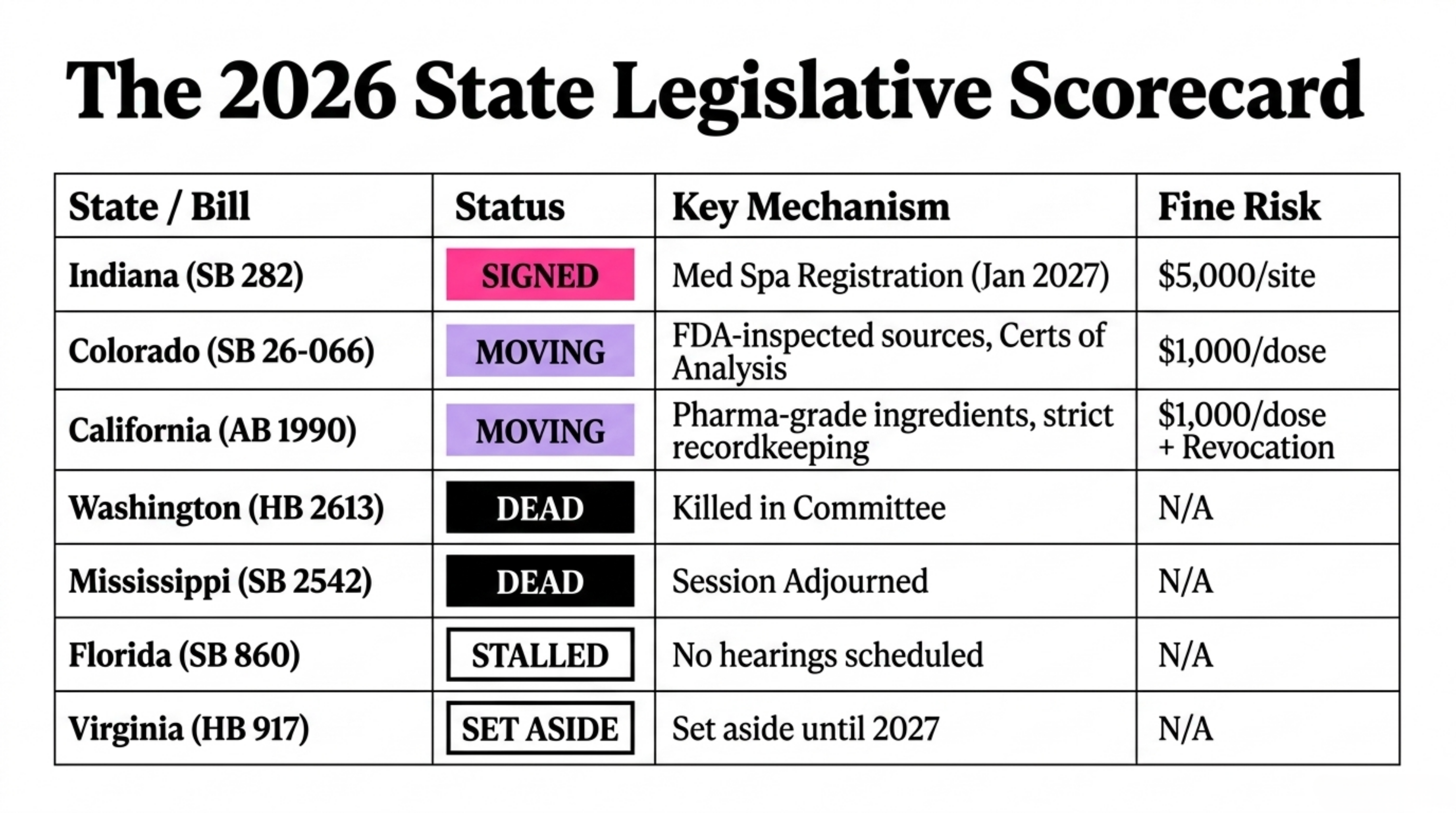
Florida SB 860 / HB 877: STALLED SB 860 was filed December 10, 2025 by Sen. Bradley and referred to three committees, but no hearings have been scheduled. HB 877 is in the same position. Florida's session is effectively over for these bills. Patient impact: Florida-based compounding pharmacies can keep shipping under existing federal and state rules for now. Worth watching for re-introduction in the 2027 session, especially given Florida's role as a major compounding hub.
Washington HB 2613: DEAD IN COMMITTEE Killed thanks to the Washington State Pharmacy Association and compounding allies. Patient impact: Washington patients keep their compounded options for now. Direct proof that organized opposition works.
Mississippi SB 2542: DEAD IN COMMITTEE Died February 3, 2026. Mississippi's session adjourned April 5, so it's done for the year. Patient impact: Mississippi compounded GLP-1 access stays unchanged through 2026. Bills can return next session.
Virginia HB 917: SET ASIDE A similar bill in Virginia was set aside in committee until next year, thanks to advocacy from the Virginia Pharmacy Association. Patient impact: Virginia stays the same for now, but the bill could come back in the 2027 session.
What you can do
Three state bills dead, one stalled, two actively moving, one signed into law. States are testing different versions of the same regulatory framework, and the ones that pass become the model. The federal bills sitting in Washington could change the equation everywhere at once.
1. Comment on the FDA proposal by June 30. One click here, then “Submit a public comment.” Tell them your story. Real patient voices stand out in a docket full of industry lawyers.
2. Call your reps about the SAFE Drugs Act. Capitol switchboard: (202) 224-3121. Ask for your rep’s office, give your zip code and one sentence about why you oppose it. Done.
3. Get on the right list. Alliance for Pharmacy Compounding is how Washington and Virginia killed their bills.
4. Tell your story out loud. Substack, social, the GLP-1 Collective, journalists. The same story you write for the FDA docket works everywhere.
If you only take one action, make it #1. The FDA is legally required to read every comment that hits the docket, yours included.
Never forget, when you advocate for yourself you advocate for all of us. 📢✊
Really appreciate how clearly you laid out the FDA's case here — the 455+ adverse event reports tied to compounded semaglutide is a stat that deserved far more mainstream visibility. The tension between safety and access is real, especially for patients who relied on compounded versions while brand-name supply was limited. With the June 29 comment window open, this is a critical moment for patients and clinicians to weigh in. Thank you for this!